
AI news ·
AI layoffs undermine the productivity gains companies expect from the technology
90% of executives say AI hasn't boosted productivity, per an Atlanta Fed study, as billions in investment fail to deliver gains. Research shows AI-driven layoffs and job insecurity undermine the employee sentiment needed for AI to improve efficiency.
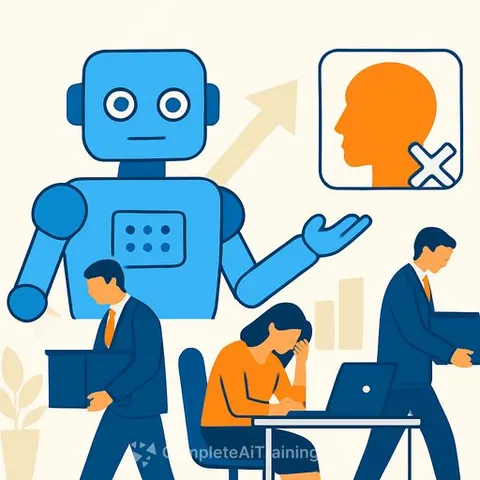
Business leaders and investors face a deepening paradox: Companies are pouring more money into artificial intelligence than ever, but they're not seeing the productivity gains they expect. An Atlanta Federal Reserve study found that about 90% of executives believe AI has not yet boosted productivity at their companies, even as billions flow into AI adoption.
Research conducted with colleagues at the University of Pittsburgh offers an explanation for why these gains don't materialize: AI-driven layoffs and the resulting job insecurity are actively destroying the conditions needed for AI to make workers more efficient. Job cuts damage employee sentiment toward AI, which is one of the strongest predictors of firm productivity when AI is used.
The layoff trap
Managers at publicly traded firms typically make decisions based on whether a new investment improves short-term profitability and share price. After investing heavily in AI, managers face pressure to show a strong financial return. The expectation is that if AI makes employees more efficient, the company will need fewer of them to complete the same work.
My colleagues and I analyzed millions of job satisfaction reviews, thousands of reports of corporate financial performance, and hundreds of AI investments and layoff announcements made by U.S. public companies over the past five years. We found a clear pattern: As the frequency of AI investment announcements rises, so too do announcements of job cuts caused by AI.
Some companies even started laying off employees before pouring money into AI, as a way to free up capital for future investments. Yet when we examined stock market reactions to these layoff announcements, the average return was close to zero. The market reaction was negative or close to zero for more than half of these events.
Why employee sentiment matters
Workers are at the center of this AI revolution and must adopt AI in their daily routines to improve their efficiency. At the same time, AI is threatening their careers and job security. By analyzing millions of employee-satisfaction reviews on Glassdoor.com, we found AI-related comments to be much more negative than the overall tone of employee reviews.
Employees cited fears over losing their jobs due to AI, a lack of appropriate training, few chances to upgrade skills, and poor corporate AI leadership. Among those topics, comments about job security concerns were the most critical by far. When companies announced layoffs due to AI, we discovered a sharp decline in sentiment.
Management sentiment tells a different story. We analyzed the tone of management discussions related to AI in about 10,000 earnings-call transcripts and found it to be consistently optimistic. That sunny outlook bore no significant relationship to productivity outcomes. Employee sentiment plays a more important role in unlocking the benefit of AI than any optimism among managers.
For decision-makers navigating these trade-offs, the distinction between workforce reduction and AI for Executives & Strategy is not academic. It is the difference between a demoralized workforce and one that treats AI as a tool for growth. Similarly, AI for Management requires understanding that layoffs in the name of AI investment undermine the very efficiency gains the technology promises.
Why this matters for executives and strategy
Laying off employees in the name of AI investment is a self-defeating strategy that offsets any expected productivity increase. Companies that make a genuine commitment to share AI gains with their employees - investing in skills and expanding opportunity rather than simply laying them off - are the ones most likely to profit from their AI investment.
Managing how employees feel is key to unlocking AI's benefits. That means creating an environment where workers feel that AI is working with them, not against them. Companies that understand the great cost of job insecurity are the ones most likely to see returns.