
AI news ·
AI literacy buffers workers against AI anxiety's worst effects
A study of 583 Chinese employees finds AI job anxiety triggers two opposite behaviors-withdrawal or proactive upskilling-depending on workers' AI literacy.
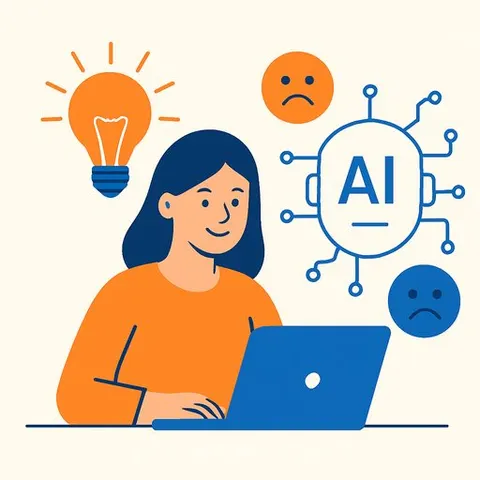
New research from Hohai University in China suggests that employees who fear AI replacing their jobs respond in two very different ways: some withdraw and narrow their roles, while others try to learn and adapt. The study, published in Behavioral Sciences, is based on three-wave survey data from 583 employees in China and identifies a key factor that influences which direction workers take: their level of AI literacy.
The findings complicate the common assumption that automation anxiety simply makes workers resistant to technology. According to the study, job replacement anxiety can push employees toward defensive behavior, but it can also trigger proactive efforts to protect employability through learning and skill development.
Anxiety Splits Workers into Two Camps
The researchers distinguish between "approach job crafting" and "avoidance job crafting." Approach crafting means proactively expanding skills, adopting new technology, and taking on broader responsibilities. Avoidance crafting means the opposite: reducing effort in uncertain areas, withdrawing from challenging tasks, and narrowing the boundaries of one's role.
The relationship between replacement anxiety and proactive behavior was not statistically significant because opposing forces canceled each other out. Anxiety weakened growth-oriented motivation, but an opposing positive association suggested that some employees try harder to remain valuable when threatened. The avoidance pathway was much clearer: fear of AI substitution was positively associated with avoidance job crafting.
For HR teams, this is the behavioral cost of AI anxiety. It may not surface as open resistance. It can appear as quieter withdrawal from experimentation, challenging assignments, or organizational change.
Anxiety Changes Motivation Before It Changes Behavior
The study examines two forms of regulatory focus: promotion focus, centered on advancement and gains, and prevention focus, centered on safety and avoiding losses. Job replacement anxiety was negatively associated with promotion focus and strongly increased prevention focus. In other words, worried employees shift attention from growth opportunities toward protecting what they already have.
That motivational shift matters because it changes behavior indirectly. Reducing promotion focus suppresses proactive job crafting. Increasing prevention focus drives avoidance-oriented crafting. The authors describe this as an inconsistent mediation pattern: anxiety simultaneously reduces the psychological drive to grow while increasing the pressure to protect.
This means organizations that treat all AI anxiety as resistance will misunderstand their workforce. Some workers may withdraw entirely, while others accelerate reskilling precisely because they feel threatened.
AI Literacy Is a Buffer, Not a Cure
The researchers define AI literacy broadly: understanding, use, evaluation and ethical awareness. Employees with stronger AI literacy are better able to judge where AI can substitute for tasks, where human judgment is still necessary, and where human-AI collaboration might create new opportunities.
The results showed that AI literacy weakened both major psychological pathways. As AI literacy increased, the negative relationship between replacement anxiety and promotion focus became smaller, and the positive relationship between anxiety and prevention focus also weakened.
However, AI literacy was a buffer, not a cure. Even among more AI-literate employees, replacement anxiety continued to activate prevention-oriented responses. Training alone cannot compensate for genuine insecurity created by restructuring, unclear workforce strategies, or poorly communicated automation plans.
For employers, the takeaway is that AI capability-building should extend beyond short courses on prompting or tool operation. The study recommends training that includes basic AI knowledge, job-specific applications, evaluation of outputs, human-AI collaboration, and ethical risks.
The AI Transition Is a Management Challenge
The study suggests that job security communication should be part of AI implementation itself, not treated as a separate HR issue. Employees need clarity about which tasks are changing, what new capabilities will be rewarded, and where human judgment remains important. Reducing uncertainty may be as important as introducing the technology.
Management practices also shape whether workers respond defensively or constructively. The authors recommend greater autonomy, employee participation in AI pilots, and room for experimentation. Employees displaying withdrawal may need additional training time, mentoring, or task redesign.
The study has limitations. The data come from self-reports and cannot prove cause and effect. Participants were recruited in China through non-probability methods, so the findings should not be automatically generalized to other countries or workforce cultures.
Why this matters for HR professionals
HR teams have a direct role in on the direction employees take when AI anxiety strikes. The study's central message is that AI literacy is a workforce resilience skill, not just a productivity tool. Those responsible for employee development should push training to include not only AI mechanics but also honest conversations about which task are changing and which skills remain valuable.
For HR leaders managing organization-wide AI adoption, AI HR Strategy Training offers a structured approach to addressing workforce anxiety, job security communication, and skill development. For HR managers working directly with employees, AI for HR Managers provides practical guidance on building AI literacy within teams that are facing uncertainty.