
AI news ·
AI model decodes the chemical signals that direct cell development
A machine learning model called IRIS can decode the chemical signals cells use during embryonic development, identifying consistent gene-activity fingerprints across cell types.
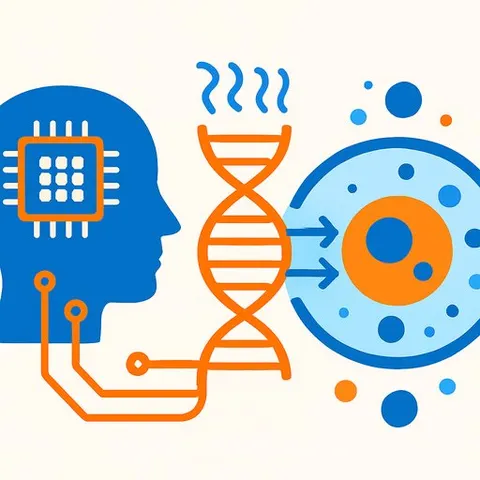
A machine learning model called IRIS can now decode the chemical signals cells use to communicate during embryonic development, researchers at the Whitehead Institute for Biomedical Research report. The model identifies unique "fingerprints" that signaling pathways leave on gene activity, and those fingerprints remain consistent across different cell types. The findings, published September 8 in Nature Methods, could accelerate stem cell engineering for regenerative medicine and improve organoid creation for drug testing.
The approach sidesteps a longstanding obstacle. Scientists previously assumed that the effects of signaling pathways varied so much between cell types that each pathway had to be mapped separately in every cell type. IRIS showed the opposite: the same pathway produces a recognizable gene activity pattern regardless of cell type, making it possible to reconstruct signaling histories at scale.
How IRIS reads a cell's instruction history
As an embryo develops, cells send and receive chemical signals through multi-step sequences called signaling pathways. These pathways translate external messages into specific changes in gene activity, telling a cell where it is, what developmental stage it's in, and what specialized role it should adopt.
IRIS is a neural network-based model trained on a large experimental dataset. The dataset measured how thousands of human embryonic stem cells responded to dozens of combinations of six major signaling pathways at multiple developmental stages. This created an atlas of how signaling combinations influence cell behavior. The model examines a cell's overall gene activity and estimates which pathways were active at specific times.
"Think of voice recognition systems like Siri, which are trained mainly in English, but then use that training to help them recognize other languages," said Pulin Li, Whitehead Institute member and assistant professor of biology at MIT. "This is called transfer learning, and this is why IRIS can work across many different cell types."
Testing predictions in mouse embryos
The team tested IRIS on single cells from mouse embryos during gastrulation, a stage when cells rapidly branch into different fates. The model accurately predicted when and where specific signaling pathways would activate in cells destined to become heart, gut, muscle, and spinal cord tissue.
When researchers used IRIS to identify signals needed for creating a cell type critical to lung development, the model predicted that activating a particular pathway would encourage lung-specific development. Experiments in mouse embryos confirmed the prediction. By identifying precise signal combinations, scientists can generate more accurate lab-grown lung tissue models.
"In these ways, IRIS is helping us decode the language cells use to talk to each other at a much faster rate than we could realistically achieve through experiments," said Nicholas Hutchins, the study's graduate student lead.
Practical applications for tissue modeling
Improved organoid models would let researchers study diseases such as asthma, lung cancer, and pulmonary fibrosis in controlled lab environments. They could test potential therapies and design regenerative treatments aimed at repairing damaged tissue. Once researchers learn the pattern of signals that drives a stem cell toward a specific cell type, they can recreate those signals to control stem cell fate in a lab or medical setting.
The model marks a shift from the traditional method of experimentally testing every pathway in every possible cell type. IRIS opens the possibility of mapping the signaling histories of every cell inside a mouse or human embryo at a scale previously out of reach.
Why this matters for PR and communications professionals
The IRIS story follows a narrative structure that resonates with non-specialist audiences: a long-standing scientific assumption gets overturned by an AI model using a familiar concept - transfer learning, explained through a Siri analogy. For communicators in biotech, health, or AI-adjacent fields, the study offers a template for translating dense technical advances into accessible stories. The key move is linking a complex method (neural network trained on stem cell response data) to a concrete outcome (lab-grown lung tissue for drug testing). When pitching similar research, lead with the practical application the model enables, not the model's architecture. The Siri comparison from Li is the kind of quote that carries a press release - specific, unexpected, and self-contained enough to survive being pulled into a headline or social caption.