
AI news ·
AI orchestration aims to connect healthcare's isolated automation tools into coordinated workflows
ModMed co-founder Daniel Cane says AI orchestration can automate multi-step healthcare workflows like prior authorizations and claims management that manual handoffs consume hours on weekly.
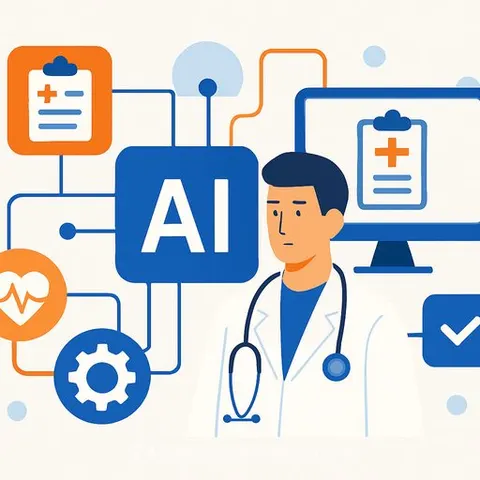
Healthcare organizations have spent the past few years deploying AI tools that handle individual tasks-ambient scribes that generate clinical notes, coding assistants that suggest billing codes. Those tools delivered real efficiency gains. But they also left a larger problem untouched: the fragmented, manual handoffs between systems that still consume hours of staff time each week for prior authorizations, claims management, payer compliance and referral coordination.
Daniel Cane, cofounder and co-CEO of ModMed, argues the industry is now approaching a second phase of AI adoption. He calls it AI orchestration-a model that coordinates multiple automated systems to execute entire workflows, not just single tasks. The concept is already taking hold in financial services, insurance and manufacturing. Healthcare, Cane said, may be next.
A shift beyond isolated automation
Most healthcare organizations already use some form of workflow automation. Patient intake systems collect information before appointments. Scheduling tools let patients book visits online. Revenue cycle platforms automate pieces of billing and collections. But these technologies typically operate independently from one another.
"While automation saves time and money, it's also limited in scope," Cane said. "Each automated process happens in a silo, making one specific task a little faster or easier."
That fragmentation creates its own friction. Staff members still move information between systems, verify data and coordinate actions across departments. Even highly optimized workflows depend on human intervention to connect the dots. For independent practices with thin administrative resources, those manual handoffs accumulate quickly. Physicians and staff can spend hours each week managing paperwork, insurance requirements and patient communications that occur after the clinical encounter ends.
AI orchestration aims to solve that by enabling multiple automated systems to work together as part of a larger process. The approach connects AI Agents & Automation that would otherwise operate in separate silos.
From ambient listening to workflow execution
Ambient AI tools provide a foundation for orchestration because clinical conversations contain much of the information needed to trigger downstream administrative actions. Cane described a scenario in which an AI assistant captures details from a provider-patient conversation and immediately translates them into tasks handled by specialized AI agents.
In a pain management visit, a physician might determine that a patient needs a new medication. Under an orchestration model, that decision could set off a chain of automated activity.
"A specialized prior authorizations agent calls up the patient's records, then uses that information to fill out insurance forms," Cane said. "Meanwhile, a formulary checks agent creates a list of effective medications, then cross-references each one with the patient's medical history."
Multiple AI agents work simultaneously in the background rather than waiting for staff to initiate each step individually. The goal is not fully autonomous decision-making. Instead, Cane described a process where AI prepares work for review while clinicians and staff retain authority over final decisions.
"By the time the doctor and patient finish their conversation, all of the agents have actions queued up, ready for human approval," he said.
Targeting the most complex admin work
The greatest opportunity for orchestration may sit in processes that involve multiple stakeholders, data sources and decision points. Claims denials, for example, can require reviewing patient records, gathering supporting documentation, completing payer-specific forms and maintaining ongoing correspondence with insurers. Referral management may involve identifying specialists, confirming network participation and scheduling across different systems.
"Traditionally, healthcare providers have relied on automating individual workflows to streamline repetitive admin work," Cane said. The limitation, he argues, is that improving one task does not necessarily improve the larger process. "What makes AI orchestration different is its ability to tackle complex, multi-step processes that draw on a variety of data sources."
In theory, AI agents could coordinate many of those activities automatically while presenting completed recommendations to staff members for review. The work gets done in the background. Humans stay in the loop for final sign-off.
The continuing need for human oversight
Despite growing interest in agentic AI technologies, healthcare leaders remain cautious about letting automated systems operate without supervision. Accuracy, compliance and patient safety concerns continue to shape deployment strategies.
"Healthcare providers make decisions that affect people's lives and livelihoods, which means that humans ultimately have to take responsibility for accuracy, oversight and compliance," Cane said.
That safeguard becomes more important as organizations expand AI use cases. Large language models can still generate incorrect information, rely on outdated data or produce hallucinations. Human review remains essential for validating outputs and ensuring that clinical and administrative decisions meet regulatory requirements. For many organizations, success will depend on finding the right balance between automation and oversight rather than pursuing fully autonomous workflows.
Why this matters for healthcare professionals
Cane frames the potential payoff of orchestration as an "intelligence dividend"-the ability to reclaim time that clinicians, administrators and support staff currently spend coordinating routine administrative activities. That reclaimed capacity could redirect human attention toward higher-value work. Providers may spend more time with patients. Administrative leaders may focus more on operational improvement and strategic planning. Staff may devote less effort to repetitive paperwork and more to handling exceptions that require judgment and expertise.
The vision depends on governance frameworks, trust in AI systems, integration capabilities and careful attention to compliance. But the core insight is that the biggest impact of AI in healthcare may not come from any single tool. It may come from the ability to coordinate countless administrative tasks that currently consume time across the enterprise-freeing professionals to do the work that only humans can do.