
AI news ·
AI program for Israeli schools expands to 180 institutions with Microsoft, Google, Amazon support
Israel named Microsoft, Google, and Amazon to power Program 720, its national AI school initiative, requiring strict security and privacy compliance. The program expands from 28 pilot schools to 180 next year, with 300 more expressing interest.
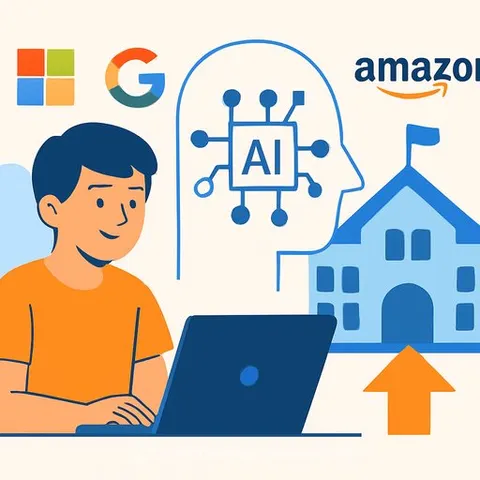
Israel's Education Ministry has selected Microsoft, Google, and Amazon to power Program 720, a national initiative that integrates artificial intelligence into the country's school system. The companies must comply with strict security and privacy regulations, according to ministry officials who spoke with the Jerusalem Post.
"This process includes extensive reviews and compliance requirements covering information security, privacy protection, accessibility, and other regulatory obligations established by the ministry," said Meirav Zerbib, Deputy Director-General and Head of the Innovation and Technology Administration at the Education Ministry.
A regulatory sandbox for rapid scaling
Program 720 operates through a "regulatory sandbox" that allows for innovation and rapid iteration while maintaining safety. This framework distinguishes the Israeli approach from countries like Germany, where heavier regulatory systems have slowed similar efforts.
The program ran a pilot with 28 schools during the 2025 school year. It will expand to 180 schools in the next phase, with 300 expressing interest beyond that. A key requirement for vendors is delivering "scalable, adaptive personalized learning capabilities" rather than isolated functions.
For the 2026-2027 school year, the program includes schools from across Israel, covering Arab, Bedouin, Haredi, Religious Zionist, and general education institutions. The aim is to give every Israeli student a unique learning experience without compromising the national curriculum.
Agentic and central AI working together
The system combines two modes of AI. Agentic AI handles day-to-day tasks: monitoring progress, taking attendance, and updating student goals. A central system gathers data to create a long-term plan for each student, adjusting content and pace in real time.
The platform is available in Hebrew and Arabic. "In the 2026-2027 school year we will continue our work to better understand the unique needs of each population," Zerbib said. "These insights will enable us to continuously refine the platform and expand culturally and pedagogically appropriate support as the program grows."
The program also reshapes the teacher's role, shifting focus from delivering material to guiding each student's academic path. For those working in education, this points to a broader need for AI for Education training that covers both tool use and the shift toward student-centered instruction.
Technical infrastructure and offline resilience
The participating platforms run as cloud-based web applications. According to Zerbib, this architecture supports high security standards, system maintenance, reliability, and continuous improvement. In the event of connectivity loss or hardware failure, the platform permits limited local work so teaching can continue, though digital features may be unavailable until the connection returns.
Teachers involved in the program will need to handle both AI tools and the new guidance responsibilities. As these systems scale, practical AI for Teachers training becomes a relevant consideration for schools planning similar implementations.
Why this matters for education professionals
For teachers and school administrators, Program 720 signals the direction of classroom AI: systems that combine centralized long-term planning with agentic daily support, tailored to local and cultural needs. The teacher's role moves from content delivery toward academic guidance. Understanding how to manage real-time adjustments, personalized paths, and the growing importance of data privacy is becoming part of the job in schools that adopt such programs.