
AI news ·
AI proposal automation risks turning hotel group sales into a price-only competition
Hotel group sales trainer Doug Kennedy warns that fully automated AI responses to RFP inquiries could reduce hotels to competing on price alone. He urges sales teams to keep humans in the loop, using AI for speed while preserving personalized follow-up to avoid a race to the bottom.
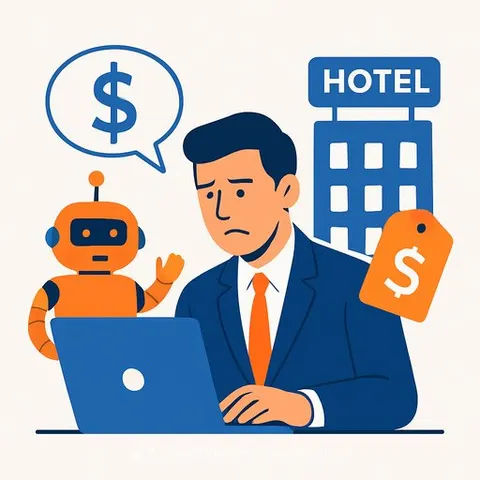
Hotel group sales teams are being told that AI can answer RFP inquiries instantly with full proposals - even one that lands at 5 p.m. on a Friday. The pitch sounds appealing: no more weekend inquiries sitting in an inbox until Monday, no more slow follow-up, no more lost leads because a competitor responded first. But Doug Kennedy, president of the Kennedy Training Network, argues that fully automated proposal responses carry a serious risk: they may turn hotel group sales into a commodity where price is the only thing that separates one property from another.
Kennedy, who attended recent HITEC and HSMAI Commercial Strategy conferences, watched a demonstration where a sales CRM provider showed how AI could process a SMERF group inquiry and respond almost immediately with a complete proposal. He acknowledged the appeal: "There was certainly a lot of validity in the example he used, which was how a SMERF group inquiry arriving at 5 p.m. on a Friday would sit there all weekend, and most likely longer, until a busy hotel salesperson finally digs the inquiry out of a stuffed inbox on Monday."
But he also flagged real-world complications that automated systems would need to handle. What happens when inventory is on hold and near the cut-off date? A human salesperson would recognize that nuance. What if the buyer submits incomplete information? What about requests for rates slightly below what the revenue system calls for, but that could generate stronger ancillary revenue? Kennedy said these are the kinds of inconsistencies that show up in most genuine inquiries.
What the buyer sees
Even if AI resolves those technical challenges, Kennedy's bigger concern is what the experience looks like from the buyer's side. Imagine a planner submits RFPs through CVENT, a local DMO, or a tourism website. Within minutes, they receive six or a dozen auto-generated proposals. "Based on my experience with AI-authored sales solicitations I receive, the wording of the correspondence and even the design is going to be homogeneous," he said.
That homogeneity is the problem. If every proposal arrives instantly, reads the same, and sells similar product in similar locations, what's left to differentiate on? Kennedy's answer: not much. "Once AI takes away the P for people, and their unique ways to make emotional connections and win confidence, and with product and place being similar, the last remaining P is price."
The result, he warns, could be a race to the bottom. "At best, a level playing field resulting in each getting only its fair share. At worst, there is a race to the bottom, where hotels sacrifice rate to gain occupancy."
Keeping humans in the loop
Kennedy isn't arguing against AI - he describes himself as an early adopter. Instead, he suggests hotel leaders use automation creatively while keeping people at the center of the sales process. For simple inquiries where AI can generate an accurate proposal around the clock, he recommends telling the buyer that a human salesperson will follow up on the next business day. Add a short personalized video message with the auto-response. Pick up the phone, even if it goes to voicemail - it leaves a human footprint on the sales journey.
He also suggests using AI to personalize responses rather than just speed them up. Train AI to improve your message wording, add people into generic empty meeting room photos, research prospects and their events, and use that information to personalize the opening of a human-written response. Scheduling tools like Calendly can make it easy for buyers to book a call or video meeting. "Encourage people to meet online and turn your webcam on," he said.
For those working in hotel group sales, the practical takeaway is to treat AI as a speed tool, not a substitute for relationship-building. The technology can handle the repetitive parts of an RFP response and shorten response times - but the emotional connection, the confidence-building conversation, and the nuanced judgment about inventory and pricing still belong to people. Buyers may get proposals faster, but they'll still remember the salesperson who called, showed up on video, and tailored the pitch to their event. That's how hotels avoid competing on price alone.
For more on applying AI in hotel and event sales roles, see AI for Hospitality & Events and AI for Sales.
Why this matters for hospitality and events professionals
If your hotel adopts automated RFP responses, the speed advantage will quickly disappear as competitors do the same. The differentiator won't be how fast you reply - it will be what happens after the proposal lands in the buyer's inbox. The salespeople who keep a human touchpoint in every automated workflow, who use AI to research and personalize rather than just generate, and who pick up the phone will be the ones who win on value instead of price. Start by auditing your current RFP process: where can AI speed things up, and where can you insert a human moment that a competitor's automation won't replicate?