
AI news ·
AI screening creates new recruitment bottleneck as CV volumes surge
Job postings now draw roughly three times more applications than in 2024, with 75% of CVs filtered out by applicant tracking systems before a recruiter sees them. Nine in ten companies use AI in hiring, but only a quarter of candidates trust it to judge them fairly.
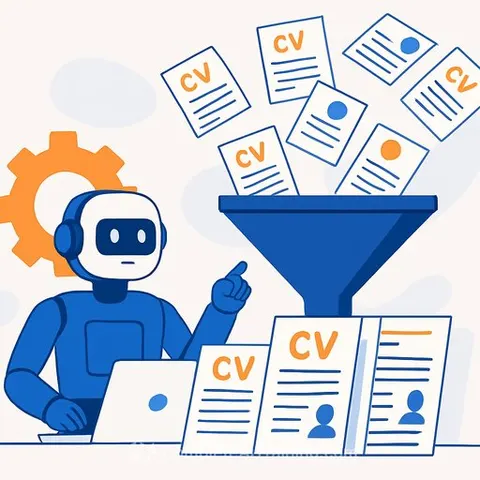
Job postings now attract roughly three times more applications than they did in 2024, and most of those CVs never reach a human reviewer. Research cited by Careerfit shows that 75% of CVs are filtered out by Applicant Tracking Systems before a recruiter sees them, while LinkedIn hosts over 12 million job applications daily in 2025 - about 9,000 per minute.
This surge has created a feedback loop. Candidates use AI tools to extract keywords from job descriptions and stuff them into CVs, producing pools of near-identical applications that are harder to sift through than the noisy ones ATS tools were built to filter. "This has bombarded talent acquisition teams with identical CVs, making it difficult to sift through 600 applications that seem 'perfect'," said Presha Chokshi, Research and Marketing Manager at Careerfit.
AI speeds up screening, but trust lags
Nine out of ten companies now use AI in recruitment. The productivity gains are real: AI can interview 40 to 80 people per day, compared with six to ten for a human recruiter, and structured AI interviews predict job performance more reliably than unstructured human interviews. Yet candidate trust has not kept pace. Two-thirds of candidates have experienced AI interviews, but only a quarter believe the system judges them fairly. Candidates report similar levels of bias in AI interviews as in human ones, with particular concerns about discrimination against neurodivergent applicants, non-native speakers, and non-traditional career paths.
Google's DeepMind recently added manual application forms alongside its AI screening because it worries the AI might reject strong candidates. The question Chokshi raises: if candidates have AI tools and companies have AI stacks, why does time-to-hire still take 30 to 45 days?
The cost of ghosting candidates
The volume problem has damaged the candidate experience. One in two candidates report being ghosted by employers - no update, no explanation. Many receive auto-rejection emails within a minute of applying. That has financial consequences. A strong employer brand can cut cost-per-hire by up to 50% and reduce turnover by 28%, and companies that invest in employer branding see roughly a 3.5x return over three years through faster hiring, lower costs, and higher retention.
Chokshi argues that companies need to publish their screening criteria, especially where individual feedback is impractical at scale. She also recommends verifying candidates' public profiles, including LinkedIn, to check for genuineness and fit - a practice she acknowledges "might come off as a little invasive" but is increasingly common.
Where the human still fits
The emerging consensus for 2026 is a hybrid model: AI handles the repetitive 70% of recruitment work, while humans keep the 30% that requires emotional intelligence and relationship-building. "A problem created by AI cannot be solved by adding more AI layers," Chokshi said. "Screening processes now need greater transparency around false-negative rates and a sense of ownership from employers when AI tools hallucinate or don't deliver optimal results."
One multinational conglomerate compressed a six-month hiring cycle to two weeks using this approach. A 300-role campaign generated tens of thousands of candidates; AI screened, ranked, and interviewed the entire pool within the company's existing ATS, while recruiters retained control of the workflow.
HR teams facing high application volumes need to define where automation ends and human judgement begins. That means publishing screening criteria, tracking false rejection rates, and ensuring a person reviews borderline cases. For those building these systems, resources like AI for Human Resources and AI for Recruitment Coordinators offer practical grounding in where AI helps and where it needs oversight.
Why this matters for HR professionals
For recruiters and talent acquisition teams, the practical takeaway is to measure what your ATS rejects, not just what it accepts. If you cannot quantify your false-negative rate, you cannot defend your screening process when strong candidates slip through. Build a review step for borderline applications - the ones that score just below your threshold - and make sure a human sees them before rejection. Speed without judgement is just noise at scale, and in high-volume recruitment, the cost of that noise is measured in lost candidates, damaged employer brand, and longer time-to-hire.