
AI news ·
AI shifts junior legal tasks to machines as senior judgment becomes the new bottleneck
AI compresses junior legal work from days to minutes but creates a bottleneck as senior partners must still verify every output. Without routine tasks, the path for junior lawyers to gain judgment required for partnership narrows, forcing firms to rebuild training around mentorship.
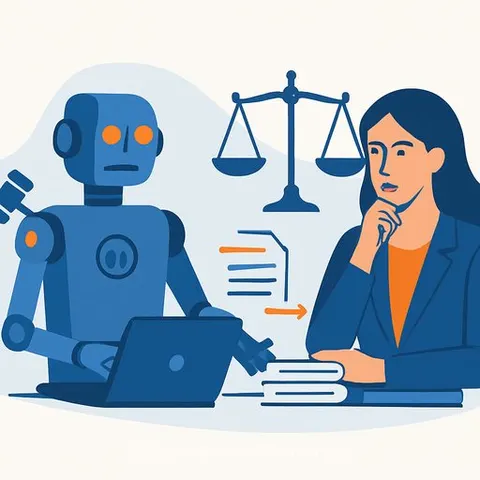
AI is compressing the hours once spent on junior legal work, but it is not compressing the judgment required to check that work. The result is a bottleneck forming around senior partners and experienced reviewers who must still sign off on every output, even as the tasks beneath them shrink from days to minutes.
Erin Cowling, CEO and founder of Toronto-based Flex Legal Network, said tech-forward small firms are shifting tasks like timelines and first drafts of statements of claim or defence to AI. "The associates are doing things faster with AI, but the partner still has to review it, still has to have that senior judgment," she said. The grunt work is compressed. The judgment is not.
The same disruption is hitting large firms. Matthew Peters, partner and national leader of transformation at McCarthy Tétrault LLP, said he gets an email "probably every other day" from a lawyer stunned by how much a new tool has sped up their workflow. He recently watched a review that would have taken six hours finish in one. "This is no longer something coming; this is now here," he said. Clio's 2025 Legal Trends Report documents the same surge in AI for Legal adoption across firms of every size.
The reviewer bottleneck
Speed for associate-level work is real, but the output still must be routed through a reviewer. Allison Speigel, a partner at Speigel Nichols Fox LLP in Mississauga, Ontario, said that even when an AI summary is "totally correct," she still ends up "wanting to go to the documents," because in litigation, a few words can change a case. That instinct is also a professional duty. The Law Society of Ontario's guidance on AI obligations tells licensees that AI output must be independently verified by a human, not by the tool itself.
The commercial pressure leaves little room to wait. Clients, Cowling said, will not "pay for hours and hours and hours for something that AI could do in two minutes." That pressure is accelerating. Peters predicted that within three years, the gap between firms that have integrated this well and those that have not will be visible to clients and recruits alike.
The training conundrum
If routine work vanishes, the path to senior judgment narrows. Paul Saunders, chief strategy and innovation officer and partner at Stewart McKelvey in Halifax, calls it the "AI training conundrum." He is blunt about the stakes. "If you're not doing that lower-level work, how do you then graduate to the higher-level skills that you will need to be a partner and a senior lawyer?" he asked.
Saunders learned how contracts work by grinding through leases line by line on due diligence files. That apprenticeship vanishes the moment a junior uploads hundreds of leases and gets an automatic summary. He is now pressing for a training overhaul to protect junior lawyers precisely because that path is closing.
Rebuilding teaching around the technology
His answer is not to slow the technology down but to rebuild the teaching around it. Firms, he argued, need to "double down on traditional mentorship" - bringing juniors into client meetings and boardrooms so judgment transfers in real time - and to reward that coaching through compensation rather than treating it as invisible labour. He wants law schools pulled into the redesign too, so graduates "hit the ground running when you get into that environment, not start from scratch."
His recent warning to a Dalhousie University law class captures the urgency: "AI will not replace lawyers, but lawyers that use AI will replace those that don't," he told them. For paralegals and junior legal staff, the shift toward AI handling document review and research means an AI Learning Path for Paralegals is becoming a practical necessity, not a theoretical option.
Why this matters for legal professionals
The bottleneck is not a technology problem; it is a training and liability problem. Every lawyer who uses AI to accelerate junior work still carries the professional obligation to verify the output independently. That means the time saved on drafting must be reinvested in review, not simply banked. For associates and paralegals, the narrowing of routine work demands a deliberate plan to acquire judgment skills through observation, mentorship, and direct client exposure before those opportunities disappear. Firms that treat mentorship as billable strategy rather than invisible labour will be the ones that close the gap.