
AI news ·
AI summaries risk replacing critical thinking in students, not just their writing
Students are outsourcing critical thinking to AI summaries that filter, flatten, and commercialize information while appearing authoritative. Universities must teach students to question AI outputs, not just use them.
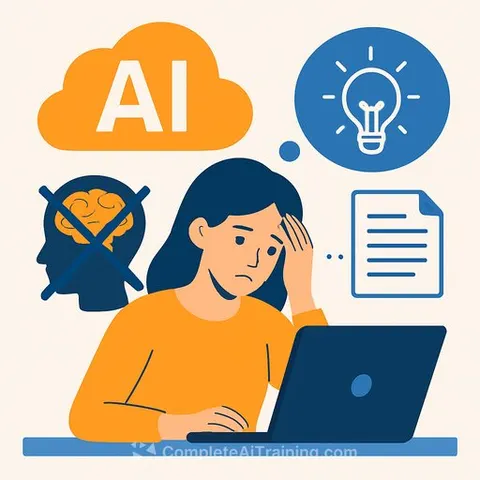
AI summaries are replacing critical thinking in higher education
Universities face a problem that looks efficient but undermines their core purpose: students increasingly accept AI-generated answers without question, bypassing the intellectual work that defines academic inquiry.
The shift is subtle. Where students once searched for information-evaluating sources, weighing competing perspectives, judging credibility-they now receive single, polished responses from AI systems. The friction is gone. So is the habit of critical thinking.
The problem isn't falsehood. It's selectivity.
AI systems don't typically lie outright. Instead, they filter. Built from vast amounts of scraped content-Wikipedia, Reddit, YouTube reviews-these systems synthesize information in ways that appear authoritative while quietly privileging certain perspectives over others.
A student researching a university, policy issue, or scientific debate encounters what looks like balanced analysis. What they're actually seeing is a filtered view, shaped by the uneven sources AI trained on.
Unusual claims get amplified
AI systems identify patterns by surfacing what stands out. An outlier-a striking claim, a highly negative review, an atypical interpretation-that would be buried in traditional search results can be elevated in an AI summary, simply because it's distinctive.
This "force-multiplier effect" means marginal perspectives can be presented as representative. Once that framing takes hold, it shapes the entire research project.
Advertising is moving into answers
Search engines already operate under commercial pressure. That logic is shifting into AI-generated responses. As advertising embeds itself in these systems, the boundary between information and promotion blurs.
For students and researchers, the risk is clear: the most persuasive answer might not be the most accurate, but the most optimized for visibility or profit.
The real risk: thinking less
Concerns about AI and student writing are valid. But the deeper problem is cognitive. If students use AI summaries as starting points-or worse, as substitutes for inquiry-they bypass the intellectual work that matters: weighing competing claims, identifying gaps, grappling with uncertainty.
AI systems are designed to optimize user experience by reflecting back what users are likely to agree with. In disciplines built on contestation and critique, this creates a fundamental contradiction. The system narrows the range of perspectives students encounter, when higher education depends on broadening it.
What universities should do now
Banning AI is neither realistic nor wise. Students need to know how to use it. The answer lies elsewhere.
Make the system visible. Students must understand how AI generates answers: what data it draws from, how it prioritizes information, why certain outputs appear authoritative. Understanding the mechanics should be part of the curriculum.
Build AI literacy, not just AI skills. Using AI effectively differs from understanding it. Train students to interrogate outputs: What perspectives are missing? What sources are privileged? How might the answer change with different framing? Assignments should reward questioning answers as much as providing them. Prompt engineering matters less than critical evaluation.
Confront everyday bias. Bias in AI rarely appears as outright falsehood. It appears as preference-what users like, believe, or expect shapes what the system returns. Students mistake personalized outputs for objectivity without awareness of this dynamic. Self-reflection becomes a critical academic skill: What are my preferences? How might someone opposing my view see this? How is AI framing this to match my preconceptions?
Treat AI as an object of study. Educators implementing these changes need guidance. AI for Teachers provides frameworks for teaching these concepts in practice.
The stakes are intellectual, not technical
AI will become faster and more convincing. That's precisely the problem. The smoother the response, the easier it is to accept without question. The more that happens, the further universities drift from their purpose: not just delivering answers, but cultivating the capacity to question them.
The risk isn't that AI will think for us. It's that we slowly forget how to think without it.