
AI news ·
AI takes on a larger role in school transportation but experts urge caution
Only 33% of school transportation staff have organization-wide AI policies, even as 65% use AI at least occasionally, with 82% relying on it for emails. The STN EXPO panel warned that uploading sensitive data to unapproved tools poses serious security risks without formal guidelines.
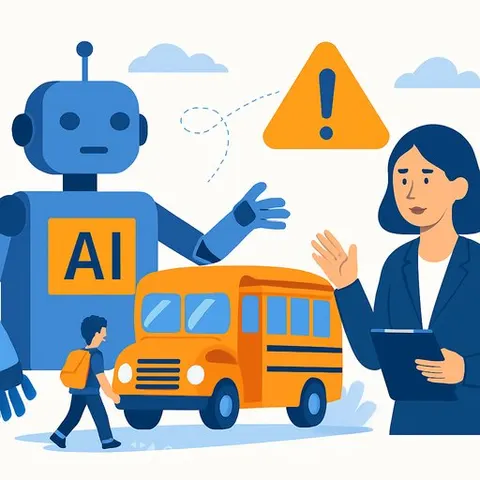
A new session track at STN EXPO West in Reno, Nevada on July 14 marked the first conference event dedicated entirely to artificial intelligence in school transportation. The sessions covered dispatch, budgeting, fleet management, risk mitigation, and bell schedules, reflecting a growing interest among transportation directors in using AI to reduce manual workloads and improve operational decisions.
The opening panel, "Beyond ChatGPT: The AI Revolution in Student Transportation," brought together Richard Jimenez of Placentia-Yorba Linda Unified School District, Timothy Purvis of Pupil Transportation Information, GP Singh of Bytecurve and Transit Technologies, and Rosalyn Vann-Jackson of Broken Arrow Public Schools. Moderated by STN Editor-in-Chief Ryan Gray, the discussion focused on defining what AI actually does in a fleet setting and what it does not.
Where districts are applying AI today
Jimenez described how his California district uses AI to streamline compliance documentation, manage IEP and IDEA processes, draft legal messaging to parents, and summarize responses to multi-services bids. Broken Arrow's Vann-Jackson highlighted applications in policy analysis, comparative studies on sick leave and overtime for special education aides, and handling public records requests.
The panelists identified a wide range of operational use cases. These include predictive maintenance, vehicle diagnostics, telematics, dispatch automation, field trip planning, attendance tracking, and master bell schedule optimization. On the personnel side, districts are experimenting with driver coaching, behind-the-wheel assessments, accident analysis, training plan development, safety modules, and automated performance reviews.
Survey data from 23 attendees showed 65 percent use AI at least occasionally or daily, with ChatGPT as the dominant tool. Writing emails and communications topped the list at 82 percent, followed by customer and parent communication at 59 percent, policy or document drafting at 45 percent, and training materials at 41 percent. Only 32 percent use AI for data analysis and reporting, and routing and logistics support sits at just 9 percent.
Security risks and the policy gap
Tim Purvis warned about data exposure risks when uploading field trip bids, public records requests, or contracts into AI tools. He reinforced the "bad data in, bad data out" principle and said districts need formal policies governing AI use. The survey confirmed this gap: only 33 percent of respondents had organization-wide guidance, and 68 percent cited lack of training as the main barrier to adoption.
Singh distinguished true AI from simple automation, noting that genuine AI synthesizes data from multiple sources to produce actionable insights. He recommended retrieval augmented generation, or RAG, for outputs grounded in verifiable facts. The panel's recommended safeguards included using only IT-approved and licensed tools, enforcing multi-factor authentication, and never uploading confidential or personally identifiable information.
Keba Baldwin, director of transportation for Prince George's County Schools in Maryland, said on the School Transportation Nation podcast that his district has adopted AI policies and blocks tools like ChatGPT and Claude that fail its security standards. Even so, PGCPS has expanded AI use from drafting emails to analyzing data. "I'm thankful it's helping to cut some of our workload in half," Baldwin said. "But the technology is still developing, and we just want to keep up with it."
Context engineering and vendor questions
Panelists stressed the importance of "context engineering" - giving AI tools detailed prompts of roughly 300 words tailored to a district's needs. They recommended gradual staff adoption, internal model training, and continued human review to catch errors and prevent AI-generated misinformation.
For directors evaluating vendor claims about AI integration, Baldwin advised asking pointed questions about infrastructure alignment, implementation timelines, customer support availability, and whether the vendor meets district security standards. "At the end of the day, I need to know if their infrastructure can align with my infrastructure to get us the outcome," he said. Technology demos, he added, remain surface level and directors should get into the specifics of what is actually being offered.
Cathy Whitney, transportation coordinator at Glenn County Office of Education in California, said her biggest fear is getting wrong information and using it in a report. "When I was at the STN conference, they kept saying check and make sure that the information is correct. We already do that in our regular lives every day," she said. Her takeaway was to learn more about what AI can do to save hours of manual data work.
Why this matters for managers
For transportation managers, the STN EXPO sessions make one point clear: AI tools are spreading fast through school fleets, but most districts lack the policies and training to use them safely. The immediate opportunity is in communication and document drafting - areas where 82 percent of early adopters already see value. The AI Learning Path for Transportation Managers covers fleet optimization, route planning, and logistics applications that align with the use cases discussed at the conference. The risk lies in uploading sensitive data to unapproved platforms without security review. Managers who establish clear guidelines, restrict tools to IT-vetted options, and build internal review processes will get the productivity gains while avoiding the data exposure and misinformation problems the panelists flagged.