
AI news ·
AI tool spots heart disease from ECGs in under two seconds
An AI tool detects heart failure and heart valve disease from a routine ECG in under two seconds. In a 67,000-patient trial, it identified up to 81% of heart failure and 90% of valve disease cases.
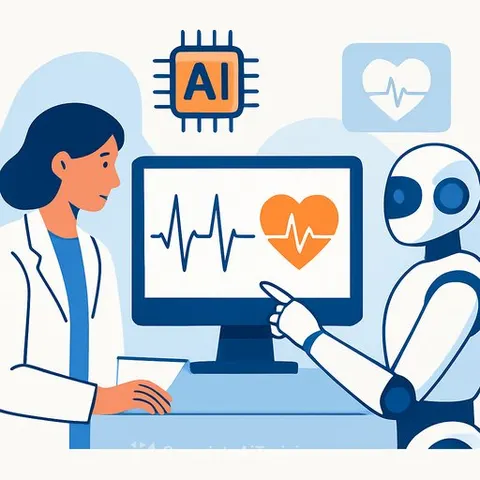
Doctors have developed an AI tool that can detect signs of two common forms of heart disease - heart failure and heart valve disease - from a routine electrocardiogram in under two seconds. The tool, trained on data from millions of patients, extracts information from ECG readings that the human eye cannot typically see, offering a potential route to much faster diagnosis for conditions that currently require echocardiogram scans and months-long waits.
Details of the technology were presented at the European Society of Cardiology annual congress in Munich to thousands of delegates. The development carries weight because ECGs are among the most frequently performed medical tests worldwide - roughly a billion each year - yet they have historically been unable to detect heart disease directly.
How the AI extracts more from an existing test
A traditional ECG records the heart's electrical activity, rate, and rhythm. For a century, it has helped diagnose heart attacks and abnormal rhythms. However, spotting heart failure or heart valve disease has required an echocardiogram, a type of ultrasound scan. Patients referred for one often wait several months.
The new AI model changes that equation. In a trial involving 67,000 patients in the US, funded by the British Heart Foundation, the tool identified up to 81% of those with heart failure and up to 90% of those with heart valve disease. It does not replace the echocardiogram as a definitive diagnostic tool, but it gives a strong indication that someone may have one of the conditions.
Dr Sonya Babu-Narayan, a consultant cardiologist and clinical director at the British Heart Foundation, said: "It is exciting to see that AI can now deliver a read-out from an ECG in what feels like the blink of an eye." She added that the technology "could be a solution to help fast-track the patients who are most likely to have a heart abnormality. When it comes to the heart, earlier diagnosis and treatment saves and improves lives."
Cutting waiting times and catching hidden cases
Prof Fu Siong Ng, a professor of cardiology at Imperial College London, pointed to the practical impact on waiting lists. "Patients can often wait several months for a heart ultrasound scan after being referred for one by their doctor," he said. "This makes it exciting that our technology could identify patients most at risk of heart failure and heart valve disease, so they could be prioritised for scans faster and more urgently."
Beyond speeding up diagnosis for those already suspected of having heart disease, Ng described an opportunistic use case: running the AI model on all ECGs conducted in a hospital. That could flag people at high risk who underwent the test for an entirely different reason, catching the conditions earlier in patients who had no prior suspicion of heart disease.
Dr Ahmed El-Medany, a BHF clinical research fellow who led the Imperial College London analysis, called the tool a "superhuman AI" and said the next challenge would be designing handheld AI-led ECG readers that healthcare professionals could use directly. This research sits within a broader push to apply AI to routine medical tests - one of several ways AI for Healthcare is being explored to speed up diagnostics.
AI reads faces for high blood pressure and diabetes
Separate research presented at the same congress showed that AI-based analysis of short facial videos can detect undiagnosed high blood pressure and type 2 diabetes. Researchers from the University of Tokyo and the Institute of Science Tokyo found that analysis of five-second facial videos could improve diagnosis for millions who are unaware they have either condition.
Both advances reflect a wider trend in AI for Science & Research, where machine learning models are being trained to spot patterns in standard clinical inputs - from ECGs to facial scans - that human clinicians cannot perceive. The ECG study was published alongside the conference presentation.
Why this matters for healthcare and research professionals
For professionals working in general healthcare, science, and research roles, the ECG AI tool signals a shift in how frontline diagnostic workflows could operate. A test that takes seconds, runs on existing equipment, and flags high-risk patients without adding new hardware could reshape triage for cardiology referrals.
The trial data - 81% detection for heart failure, 90% for valve disease - gives a concrete performance benchmark. The real-world implication is not that AI replaces echocardiograms but that it reorders the queue: patients flagged as high-risk can skip months of waiting. For researchers and clinical leads, the next milestone will be watching how the proposed handheld ECG readers perform outside controlled trials, in the settings where most of those billion annual ECGs are actually taken.