
AI news ·
AI use in writing risks homogenising human thought, researchers say
AI large language models risk making human writing and reasoning more alike, a September 2026 study warns, as users who rely on AI without heavy editing converge on similar styles and thought patterns.
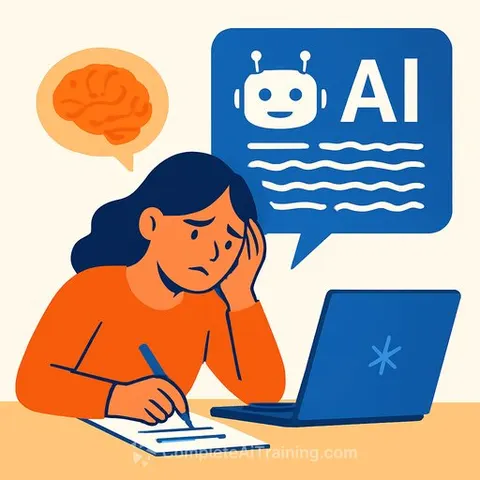
The growing use of AI large language models could make human writing, perspectives and reasoning more alike, according to a research paper that raises questions about creative diversity and authorial voice.
The findings, published in September 2026, suggest that as writers and professionals adopt AI tools to draft emails, articles and creative work, the technology may inadvertently narrow the range of expression and thought patterns across entire populations of users.
What the research found
The study examined how large language models influence writing output when humans interact with them regularly. Researchers identified a pattern of convergence - users who relied on AI assistance began producing text that resembled the model's own style and each other's work more closely over time. The paper warns this effect could extend beyond word choice into the underlying structure of reasoning and perspective-taking.
"The risk is not just stylistic mimicry but a gradual narrowing of the conceptual frameworks people use to approach problems," the researchers said. The homogenisation effect appears strongest when users accept AI-generated text without substantial editing, a habit that becomes more common as trust in the tools increases.
Implications for authorial voice
For writers, the concern centres on what makes individual work distinctive. An author's voice emerges from specific word choices, sentence rhythms and angles of thought accumulated over years. When AI suggests the same phrasings to thousands of users facing similar prompts, those individual markers begin to blur.
Publishing professionals have already observed early signals. Oxford University Press updated its author guidelines after finding that AI use was "measurably" under-disclosed in submissions. The combination of undisclosed AI assistance and homogenised output creates a dual challenge for editors trying to identify original work.
The research does not argue against AI use entirely. Rather, it points to the importance of conscious engagement - treating the technology as a starting point rather than a final draft, and preserving the deliberate choices that constitute a writer's signature approach.
How the publishing industry is responding
Several publishers have begun revising their policies. The updated guidelines from Oxford University Press reflect a broader industry push for transparency around AI-assisted writing. Trade organisations are also developing standards that acknowledge the technology's role while protecting the value of human-authored work.
Some independent bookshops and imprints have started highlighting works that explicitly exclude AI involvement, treating human-only authorship as a marketable attribute. This mirrors similar movements in journalism and academic publishing, where disclosure requirements are becoming more common.
Why this matters for writers
The homogenisation risk lands squarely on a tension every working writer faces: efficiency versus distinctiveness. AI tools can handle routine drafting tasks quickly, but the research suggests that speed comes at a cost to the very thing that makes writing valuable - an unmistakably human perspective. Writers who treat AI output as raw material to reshape, rather than finished text to accept, are less likely to see their voice converge with the crowd.
For those building careers on their ability to think and write differently from everyone else, the paper offers a practical warning. The technology that promises to remove friction from the writing process may also remove the friction that produces original thought. Understanding Generative AI and LLM technology helps writers make informed decisions about when and how to use these tools without surrendering what makes their work distinct. Writers looking to integrate AI without losing their voice can explore AI for Writers resources that focus on maintaining authorial control.