
AI news ·
AI Won't Take Your Job-It's the Best Time to Be a Builder
Jobs shift, not vanish, as AI automates repeat work; people steer outcomes. HR should pivot to skills, safe tools, and rewards for impact.
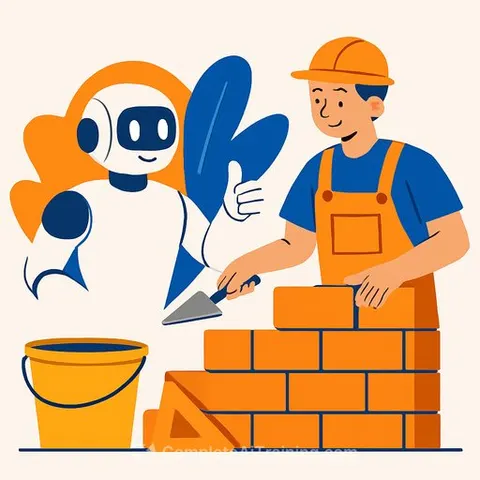
Workplace 4.0: Jobs will shift, not vanish, in the AI economy
Every major tech shift sparks anxiety about jobs. Then it creates more of them. AI follows the same pattern: repetitive tasks get automated, new creative and analytical roles emerge, and the value of work moves upstream.
Execution is getting commoditized. Your edge is deciding what to build, why it matters, and how people will use it. That changes how HR hires, develops, and measures talent.
What this means for HR
- Move from roles to skills: Build a skills taxonomy and tie it to hiring, pay, learning, and mobility.
- Redesign jobs around judgment: Let AI handle repeatable work; upskill people for problem selection, oversight, and outcomes.
- Democratize tools: Give employees safe access to AI. Standardize prompts, playbooks, and policies.
- Rebalance rewards: Pay for impact, not effort. Recognize human-in-the-loop quality, speed, and creativity.
- Create internal venture lanes: Support micro-entrepreneurs and intrapreneurs with small budgets and fast approvals.
Where AI is already changing work
- Customer support: AI drafts replies, routes tickets, and summarizes threads; humans handle edge cases and empathy.
- Content and marketing: First drafts, variants, SEO outlines; humans set voice, narrative, and strategy.
- Operations: Forecasts, scheduling, anomaly detection; humans make trade-offs and call exceptions.
- Engineering: Code suggestions, tests, documentation; humans architect systems and review risks.
- People operations: JD drafting, screening summaries, interview guides; humans evaluate fit and potential.
New roles you'll hire for
- Prompt engineers and conversation designers
- AI ethicists and risk leads
- Model trainers and data annotators
- Human-in-the-loop supervisors and QA
- AI experience designers and workflow curators
- AI operations (monitoring, drift, and compliance)
A 90-day HR action plan
- Task audit: Map top 50 tasks per function. Tag as automate, augment, or human-only.
- Pilot 3 use cases: Pick one each for productivity, quality, and customer experience. Set clear metrics.
- Skills gap analysis: Define must-have skills (prompting, data literacy, tool fluency) per role level.
- Learning paths: Launch role-based microlearning and practice labs. Tie completion to internal gigs.
- Policy and governance: Approve AI vendors, data boundaries, review steps, and audit logs.
- Talent acquisition refresh: Update JDs, interview rubrics, and take-home tasks for AI-enabled work.
- Change management: Communicate the "shift, not vanish" story. Share wins, publish playbooks, and create office hours.
Reskilling quick starts (by function)
- Support: Prompting, retrieval basics, tone control, escalation criteria, bias and safety checks.
- Marketing: Brief writing, content QA, brand guardrails, analytics interpretation, experimentation.
- HR: JD generation, screening summaries, structured interviews, internal mobility matching, policy oversight.
- Product/Engineering: Spec drafting, test generation, code review with AI, data privacy, model limits.
Policy and ethics guardrails
- Data use: No sensitive data in public models. Whitelist tools. Mask PII by default.
- Quality gates: Human review for external content, legal, and customer-critical actions.
- Bias checks: Red-team prompts and outputs. Track fairness metrics and correct drifts.
- Auditability: Log prompts, versions, and decisions. Keep reproducible records.
- Transparency: Disclose AI assistance where it affects users or employees.
Metrics that matter
- Percent of tasks augmented or automated per function
- Time-to-competence for AI skills by role level
- Quality and error rates with/without AI
- Internal mobility and career progression
- Employee sentiment on AI usefulness and trust
- Compliance incidents and remediation time
Build the micro-entrepreneur muscle
- Internal marketplaces: Post problems; let teams pitch AI-enabled solutions.
- Small bets: Fund 4-6 week experiments with clear KPIs and a sunset rule.
- Recognition: Reward shipped outcomes, not proposals.
Jobs are shifting from doing the work to directing the work. AI handles the repeatable. People handle judgment, context, and taste.
The future favors teams that pair curiosity with tools. Give your people the systems, skills, and safety to do that-then measure outcomes and keep shipping.