
AI news ·
Albanese government launches tripartite AI workplace forum, rules out union veto powers
Australia's government will regulate AI at work through a new tripartite forum but has ruled out giving unions veto power over AI deployments. Work intensification, not job loss, is flagged as the more immediate risk.
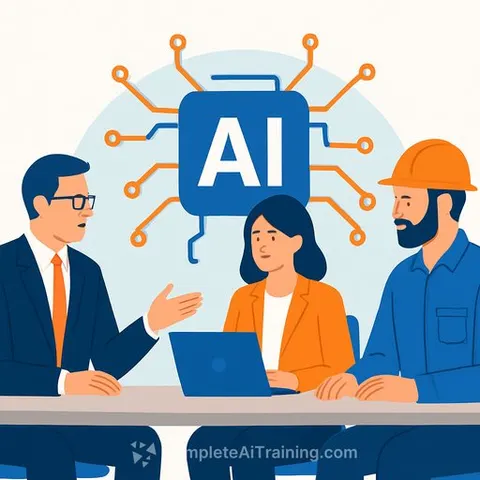
Australia's Government Sets Out AI Workplace Rules Without Union Veto Power
The Albanese government is moving to regulate artificial intelligence in Australian workplaces through a new tripartite forum, but has explicitly rejected giving unions the power to block AI deployment. Workplace Relations Minister Amanda Rishworth outlined the approach at the AFR Workforce Summit, framing regulation as a balance between protecting workers and preserving employer flexibility.
The centrepiece is the AI Employment and Workplaces Forum, which meets for the first time this week in Adelaide. It brings together the ACTU, the Business Council of Australia, the Australian Industry Group, and the Australian Chamber of Commerce and Industry. The forum will meet at least three times a year.
Rishworth commissioned a "gap analysis" to determine whether existing workplace laws can handle AI or whether new legislation is needed. She has also ruled out changes to the Fair Work Act's no-costs regime, even as AI-generated unfair dismissal claims rise.
What the forum will and won't do
The forum's role is to build a shared evidence base on AI adoption, ensure productivity gains reach workers, and test whether current laws remain fit for purpose. It will not, Rishworth said, give unions the ability to veto specific AI deployments or technologies.
That distinction matters. Business groups feared consultation could harden into effective bans. Unions have pushed for six-month notice periods for AI-related job cuts and stronger consultation duties, citing fears of hundreds of role losses.
Rishworth acknowledged the forum will not deliver "a silver bullet solution". Instead, it aims to build common language and evidence around AI so future regulation rests on facts rather than speculation.
Early labour market data shows mixed signals
The government's department will release a report next month on AI's labour market impact since ChatGPT's launch in late 2022, covering data through February 2026. Employment outcomes for young tertiary graduates-often seen as early indicators of white-collar automation-have remained positive. The overall mix of jobs in the economy is not shifting faster than usual.
However, there are signs of strain. The government detected a "slight softening" in growth for roles most exposed to AI, such as filing clerks and keyboard operators. This suggests gradual attrition in traditional administrative work.
Rishworth cautioned the data is "reflective of a particular point in time, and is not predictive". The figures also predate major technology-sector layoffs at Wisetech, Atlassian, and Bendigo and Adelaide Bank, where companies explicitly cited AI and automation as drivers.
Work intensification may pose a bigger risk than job loss
Rishworth has repeatedly flagged work intensification as a more immediate hazard than outright job destruction. As AI automates routine tasks and accelerates workflows, employers may simply increase expectations rather than redesign roles.
The result can be longer hours, greater surveillance, and performance metrics that erode psychological safety. With psychological injury claims already rising, Rishworth framed AI-related intensification as a workplace health and safety issue, not merely an innovation side-effect.
This opens a path to future regulation under existing safety laws, where employers must identify and control psychosocial hazards. It also reflects her broader principle that "trust needs to be at the centre of policy".
Five principles for responsible AI adoption
Rishworth outlined five principles that should guide AI adoption at work:
- Trust: Workers who see decisions about rostering, performance, or promotion shift to opaque software often "feel devalued". This erodes both morale and acceptance of AI.
- Transparency and capability: Employees need visibility into how AI tools work, what data underpins them, and what recourse exists if systems fail. They must also receive training to work effectively with AI.
- Safety: This includes traditional health risks and psychosocial harms from surveillance and intensification.
- Productivity: Workers must share in AI-driven productivity gains if the technology is to remain politically and socially sustainable.
Rishworth drew parallels to past industrial revolutions, noting that while living standards eventually improved, early waves of technological change were "a disaster for many" displaced workers. If Australians feel they are "training their own replacements" or treated as "disposable", AI will inflict "permanent injury" on quality of life.
Guardrails, not bans
Rishworth said she will not "close the door on regulation" of AI, particularly where psychological risks and fairness concerns arise. But any new rules must be carefully calibrated to set boundaries without freezing technology in place.
Enterprise bargaining remains her preferred mechanism for giving employees agency over AI use. With more workers covered by enterprise agreements than ever, there is scope for AI-specific clauses addressing consultation, data use, training, and job redesign by sector.
The regulatory pathway appears phased rather than a single, sweeping AI bill. It includes the gap analysis of workplace laws, the forum, and ongoing Fair Work Commission consultation about managing AI-generated claims.
The stakes for trust
Rishworth's core philosophy is straightforward: "humans must remain the master and not the servant" of AI. This means workers have genuine input into AI adoption, are not reduced to cogs in algorithmic workflows, and the technology serves human wellbeing and economic security.
Australia is "in a good position to seize the opportunity from AI, rather than to crumble under its weight", she argued. Early labour market data offers some support. But union frustration over recent tech-sector job cuts and worker anxiety about becoming replaceable are reminders of how quickly trust can evaporate.
The government's emerging approach-tripartite dialogue, evidence-based policy, guardrails on risk, and shared gains-is an attempt to shore up trust before the next wave of automation arrives. Whether it succeeds will depend less on rhetoric at summits and more on what happens in bargaining rooms, on worksites, at the Fair Work Commission, and in thousands of workplaces where AI is quietly reshaping how Australians work.
For HR professionals implementing AI systems, understanding these emerging guardrails and principles is critical. Learn more about AI for Human Resources and how to align your AI strategy with workplace regulations and worker wellbeing.