
AI news ·
Amazon's first customer service vp says reliable AI still depends on an experienced human checking its work
Amazon VP Bill Price says AI won't replace live agents but will cut handle times by 15-25% and identify "silent sufferers"-customers who never complain yet churn at rates of 70-90%.
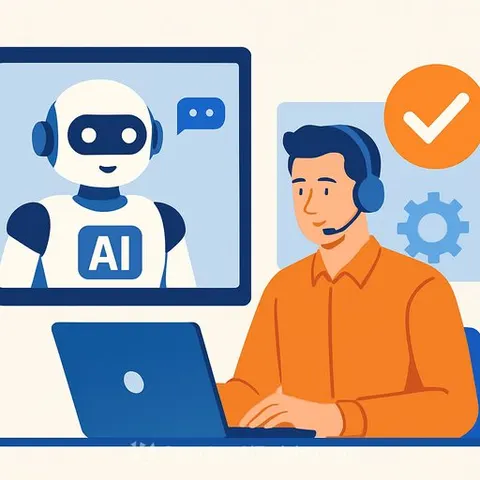
Amazon's first Global VP of Customer Service, Bill Price, says AI will not eliminate live customer support. Instead, it will transform how companies handle demand, route inquiries, and catch the "silent sufferers" who walk away without ever complaining.
In an August 2026 interview, Price outlined a three-step model where AI handles routine self-service, intelligently routes complex issues to the best-suited agent, and assists that agent in real time. He also described a new analytics approach to identify customers likely to churn - before they leave.
AI won't end live service - it will reshape demand
Price dismissed the idea that AI will replace human agents entirely. "I think the answer is no," he said. "It's going to transform the way assisted service is done, to the point that it needs to be transformed."
The first step is removing unnecessary contacts. Questions like "what's the status of my refund?" should never reach a human. AI can intercept these inquiries and provide instant answers. Price calls this demand reduction - handling the "stuff that isn't really needed" through automation.
When AI cannot resolve an issue, the second step becomes critical: routing the customer to the right person. Traditional systems default to the next available agent or broad skill groups like "billing." Price's company, Intendra AI, now scores agents based on their past conversations to match them with specific customer profiles.
"We find that if we show a sample of 50 different associates in one company, only 4 are really good with first-time customers," Price said. His system signals the routing engine to hunt for those top performers first, avoiding agents who are likely to produce a bad experience for that customer type.
The third step is Agent Assist - bots that listen to live conversations and surface relevant knowledge articles. "The bot, through machine learning, kicks the box and says, 'That's really good,'" when a suggestion works. Early results show handle times dropping by 15 to 25 percent.
Finding silent sufferers before they churn
Price and co-author David Jaffe introduced the concept of "silent sufferers" in their book The Best Service is No Service. These customers experience problems but never complain. They simply leave.
Using AI to review roughly 300 academic articles on complaint behavior, Price found that silent sufferers have churn rates of 70 to 90 percent. "They don't bother to complain. They complained in the past, or they think it won't do any good," he said.
The new approach uses pattern matching. When a few passengers on a delayed flight complain, the airline can identify all 180 who shared the same experience and reach out proactively. Price acknowledged the practice is still emerging. "It is such a new notion," he said. "I hope in another 6 months there will be 2 or 3 or more" companies with proven results.
Root cause analysis at machine speed
AI also accelerates root cause analysis - a process that once required teams of experts to listen to hundreds of contacts manually. Large language models can now scan thousands of conversations and surface the most impactful underlying problems, weighted by severity.
"AI can look through all the contact history and say, 'We think these are the 3 or 4 root causes,'" Price said. This lets teams reach what he calls "the solution space" within days, not weeks. For professionals building skills in this area, resources like an AI Learning Path for Call Center Supervisors can help bridge the gap between traditional operations and these new capabilities.
The human must stay in the loop
Price stressed that reliable AI requires an experienced person checking its work. He pointed to law firms that filed briefs with fabricated citations as a warning. "There's got to be that human-in-the-loop scrutiny," he said.
His wife, a speech therapist, demonstrates the model. She spends 30 minutes refining prompts in Copilot to generate custom therapy materials - 10 words with specific letter combinations, paired with images of a Chinese-American girl performing related tasks. "When she first gets those 10, maybe 7 are good, and 3 are nonsense. So she goes back, refines it," Price said. Her expertise is what catches the errors. For customer support teams adopting AI for Customer Support, the same principle applies: domain knowledge is the safety net.
Why this matters for customer support professionals
The technology stack is shifting, but the core job is not disappearing. Support leaders who treat AI as a tool for demand reduction, intelligent routing, and agent assistance will reduce costs without sacrificing experience quality. The bigger opportunity is proactive retention - using conversation data to find customers who are suffering in silence and intervene before they defect. That capability depends less on the AI itself and more on whether leadership is willing to invest in reaching out.