
AI news ·
AI phone agents move from pilot to mainstream as 2026 adoption surges across industries
AI phone agents have gone mainstream, handling calls that once required human representatives. Early 2026 adoption reports show average handle times dropping 30 to 50 percent.
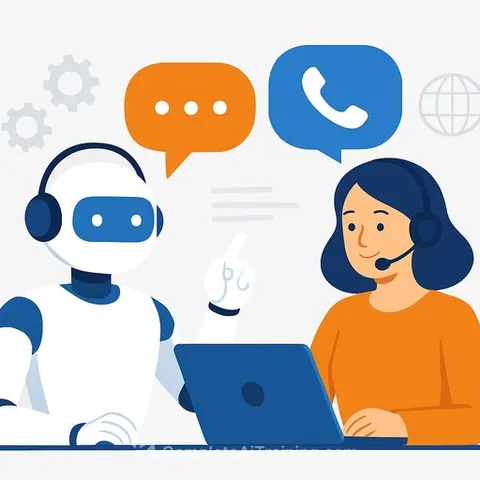
AI phone agents have moved from pilot projects to mainstream customer service in 2026. Companies across healthcare, finance, and retail report shorter wait times, higher resolution rates, and measurable cost savings as voice AI handles calls that once required human representatives.
For decades, phone support meant two options: holding for a human agent or navigating a rigid IVR menu that rarely answered the actual question. Both frustrated customers. Both cost businesses money. Human agents only worked business hours, got tired, got sick, and were expensive to train. Scaling for peak demand meant seasonal hiring, which introduced consistency and quality problems. IVR systems offered neither empathy nor intelligence.
Businesses needed something better. The shift to AI phone agents is now well underway.
What makes an AI phone agent different
An AI phone agent is not a phone tree with a new name. Modern voice AI holds natural, dynamic conversations, understands context across multiple exchanges, and resolves issues without transferring callers unless necessary. Natural language processing handles accents, interruptions, and complex phrasing. Large language models let these agents reason through problems in real time instead of matching keywords to canned responses. Integration with CRM systems means the agent already knows who is calling, what they purchased, and their service history.
Businesses using platforms like Bland.ai report response quality that rivals human agents at a fraction of the cost.
The biggest changes for customer service teams
Availability is the most immediate shift. An AI phone agent handles calls at 3 AM Sunday with the same quality as noon Monday. Round-the-clock support is now economically viable at any scale.
Scale is another. A single AI system manages hundreds of concurrent calls. During product launches or demand spikes, there is no queue, no dropped calls, no degradation in experience.
Consistency matters too. Human agents vary in tone, accuracy, and compliance with brand guidelines. An AI agent delivers the same quality every time. For regulated industries, that consistency is a necessity, not a benefit.
Resolution times drop significantly because systems pull account data and process requests in real time. Callers do not repeat themselves or wait while an agent navigates multiple systems. Early 2026 adoption reports show average handle times dropping 30 to 50 percent with proper implementation.
The best implementations do not replace human agents entirely. They make them more effective. Routine calls run autonomously, and complex cases escalate with full context attached. The human agent already knows what the caller needs and what the next best action is.
For teams building these skills, AI for Customer Support training covers the practical side of working alongside voice AI systems.
Who is adopting voice AI
Healthcare providers use AI voice systems for appointment scheduling, prescription refill requests, and general FAQs without tying up clinical staff. Financial services firms deploy voice AI for account inquiries, fraud alerts, and payment processing. Retail and e-commerce businesses handle order status, returns, and product questions entirely through automated voice conversations.
The shift is not just about cost reduction. It is about meeting customers where they are, on the phone, immediately, without friction.
The concern that voice AI displaces workers is real, but the 2026 picture is more nuanced. Businesses are reallocating human agents to higher-value work: escalations, complex accounts, and relationships that require emotional intelligence and judgment. Routine calls were rarely the ones that made agents feel engaged anyway.
Supervisors preparing their teams for this shift can work through the AI Learning Path for Call Center Supervisors, which covers automation and workforce planning.
Why this matters for customer support professionals
Industry analysts expect the majority of inbound customer service calls to be handled by AI by the end of 2026, with humans in supervisory and escalation roles. For customer support professionals, that means the job is changing whether they are ready or not. Agents who learn to work alongside AI systems, manage escalations, and handle complex judgment-based work will be the ones who keep their roles as the frontline shifts.
The companies moving fastest are not just cutting costs. They are setting a new standard for what customer service should feel like - and that standard is rising every month.