
AI news ·
AutoLabs AI agent translates experimental goals into robot instructions
AutoLabs, a new AI system, translates experimental goals into robot instructions, cutting setup from weeks to minutes. It lets researchers run 5 to 10 times more experiments.
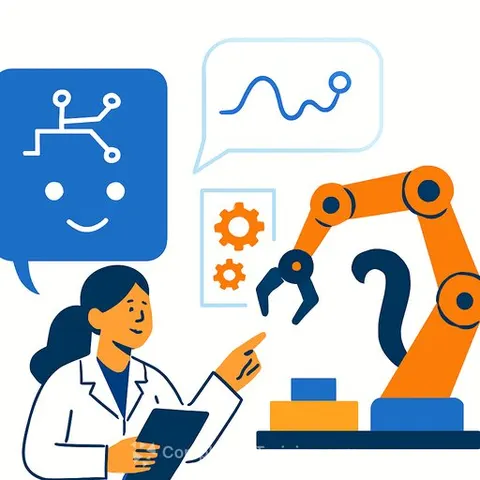
Researchers at the Department of Energy's Pacific Northwest National Laboratory have developed AutoLabs, an AI system that translates experimental goals into instructions for autonomous lab robots, cutting setup time from weeks to minutes. The system, described in a paper published June 25 in *Scientific Reports*, enables researchers to run 5 to 10 times more experiments than manual methods. The software is available for download on GitHub.
The bottleneck in autonomous research
Setting up an experiment on a robot like Big Kahuna, an automated system from Unchained Labs, requires a lengthy collaboration between scientists and instrument engineers. Each side holds specialized knowledge that does not always overlap. The process can take weeks as they refine the steps together.
Heather Job, a systems engineer at PNNL and paper coauthor, operates and programs Big Kahuna. She said, "We're lucky in the fact that we have software that goes along with our robots. But unless you have a lot of training and you know what the robot is capable of, it can take a really long time to translate what you'd like to do into the robot's specific operations."
How agentic AI translates experiments
AutoLabs uses a generative AI and LLM framework built on an OpenAI model, structured with multiple specialized sub-agents controlled by a single supervisor agent. One sub-agent analyzes the user's request while others validate the steps for the specific robot. The system handles multi-step workflows including mixing, heating, stirring, and filtering.
Gihan Panapitiya, a data scientist at PNNL and lead author, said, "AutoLabs helps pave the way for a new generation of AI-driven automatic assistants for chemistry research. Agents like AutoLabs can act as automated assistants, as well as reliable, self-correcting partners in the complex and creative process of scientific discovery."
Testing and future plans
The team tested AutoLabs with five experiments of increasing complexity, ranging from simple chemical mixing to multi-step reactions requiring heating, cooling, and precise transfers. In every case, AutoLabs correctly translated the experimental descriptions into operational steps for Big Kahuna.
Job emphasized that the tool does not replace researchers. "With AutoLabs, human experts can learn to use Big Kahuna quickly and guide the overall experimental strategy while the AI agent manages the granular implementation and validation," she said. "The collaboration creates a partnership that's more robust than either a human or robot could achieve alone."
The team plans to expand AutoLabs to conduct literature reviews and to learn over time by adding memory. Panapitiya said the system's design is flexible enough to adapt to other autonomous laboratory systems beyond Big Kahuna.
Why this matters for science and research professionals
AutoLabs shows that agentic AI can eliminate the translation bottleneck between scientific intent and robotic execution. For professionals in AI for Science & Research, the technology means faster experiment cycles and the ability to delegate routine programming tasks to a self-correcting AI partner. Researchers can focus on experimental design rather than instrument-specific coding, directly increasing lab throughput by a factor of 5 to 10.