
AI news ·
Automated customer service systems replace human help with frustration and irrelevant loops
Credit card automated systems can trap customers in endless loops, but saying "fraud" connects you to a human immediately because the company then becomes the victim.
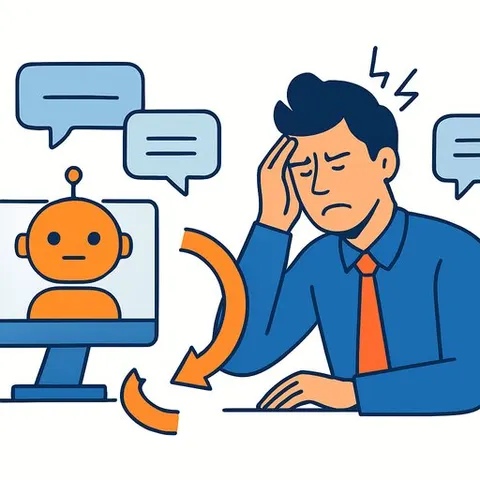
Automated customer service systems are failing the people they are supposed to help. A 50-minute hold with repetitive music, a dead-end decision tree, and an alert mistakenly labeling a customer a "sexual predator" because she lives near one - this is the reality Francine Berman describes in Better Tech: Putting People First in Cyberspace. For professionals in customer support roles, the account is a case study in what happens when algorithmic efficiency replaces human judgment.
The core problem is not automation itself. It is the design philosophy that treats all customers and their problems as identical. Most people call customer service only when something is broken. Yet automated systems are built for "common" problems. When your issue falls outside the standard path, you get trapped. "When there are no people to be found to explain things to, you may end up in an endless loop, having a bot tell you the same annoying irrelevant thing over and over," Berman writes. "How is that customer service?"
Custom service versus automated loops
Berman draws a sharp distinction between customer service and what she calls "custom service." The latter targets individual needs and contexts. She points to a bra store in Northampton where expert humans triage choices based on a customer's body, lifestyle, and preferences. The experience is fundamentally different from guessing your size on Amazon and hoping for the best.
That level of personalization does not scale easily. But some large companies manage it. Berman cites Fidelity and USAA as examples. When a website or chatbot cannot answer her question, a voice-verified bot connects her to a human who can track down the answer. USAA ranked in the Fortune 100 in 2025. Fidelity was the third-largest mutual fund company in the U.S. Apple runs its Genius Bar with real people who, Berman notes, "apparently are not allowed to make me feel stupid."
The fraud department shortcut
One practical lesson emerges from Berman's ordeal with the credit card monitoring service. After saying "agent" 25 times failed, a human finally told her the magic word was "fraud." In fraud cases, the credit card company is the victim, so a human answers immediately. Those agents can then route you to other humans who solve unrelated problems, like resetting a password. The system is gamed by design - a workaround that support professionals should understand.
This dynamic highlights a broader truth about AI for Customer Support. The technology can verify a voice or route a call, but it cannot replace empathy. Berman's central argument is not anti-technology. "Digital technologies should help us do things better, not worse," she writes. "Algorithmic efficiency is not a substitute for human empathy and judgment."
Respect as a business strategy
The companies that earn Berman's loyalty do something that automated phone trees cannot: they demonstrate respect for the customer's time and intelligence. They make knowledgeable humans available early in the process. This is not just good manners. It is a recognition that without satisfied customers, businesses can cease to exist.
For AI for Call Center Supervisors, the implication is clear. The goal is not to eliminate human agents. It is to design systems where automation handles the routine so humans can focus on the complex. A bot that verifies a voice in seconds and then hands off to a person is useful. A bot that loops a frustrated customer through irrelevant menus is a liability.
Why this matters for customer support professionals
The most valuable skill in customer support right now is knowing how to bridge the gap between automated systems and human problem-solving. Berman's experience shows that even broken systems have backdoors - like the word "fraud" - that people in the industry can document and share. The companies that win loyalty are those that train their people to listen, to triage with context, and to solve problems that no decision tree anticipated. Automation should make those people faster, not obsolete. The technology exists to do both. The question is whether companies choose to.