
AI news ·
Balancing Minds and Machines: The Complex Role of AI in Fair and Creative Educational Assessment
AI transforms education with consistent grading but struggles to assess creativity and context. A hybrid model blending AI and human insight offers fairer evaluations.
The Role of Artificial Intelligence in Education
Artificial Intelligence (AI) is steadily changing how we evaluate students and create learning environments. AI-based grading systems bring objectivity, consistency, and efficiency to the assessment process. From automated essay scoring to standardised testing, these technologies promise fair and unbiased evaluation. But can AI truly measure critical thinking and creativity? Are these systems free from bias, or do they distort results subtly? And how does this compare with human teacher assessments, which can also carry prejudices? Several reports from Indian institutions have highlighted bias in human evaluations, suggesting that no method is perfect.
Marking Subjective Work
AI performs well in assessing objective and descriptive work, especially in engineering and scientific subjects where reference answers or solution strategies exist. It can review thousands of papers quickly, easing teachers’ workloads and ensuring consistent grading. However, when it comes to subjective tasks like essays, literary criticism, or philosophical arguments, AI struggles. Such work allows multiple viewpoints and interpretations that cannot be boxed into strict criteria.
Critical thinking and creativity don’t follow rigid rules. AI finds it difficult to gauge originality, nuanced debate, or the use of metaphor and symbolism. While it can assess structure, coherence, and vocabulary, understanding abstract concepts, humor, irony, or creative flair remains a challenge. For example, philosophical questions like “What is beauty?” have no single correct answer but invite varied perspectives. Similarly, a poem like Alfred Tennyson’s Ulysses offers different meanings with each reading. AI-assisted grading finds it hard to capture the depth and originality in such responses.
Challenges
AI systems learn from large datasets of graded work, which may contain biases from human evaluators. Studies show AI sometimes favors verbose writing, penalizes non-native English speakers, or undervalues unconventional ideas that differ from common trends in the training data. Contextual understanding is another hurdle; literary or philosophical essays often depend on historical or cultural backgrounds that AI might miss.
For instance, an AI trained primarily on Western literature may misjudge works rooted in Eastern philosophy or indigenous storytelling. However, technologies like Retrieval-Augmented Generation (RAG) can help reduce misinformation and improve accuracy.
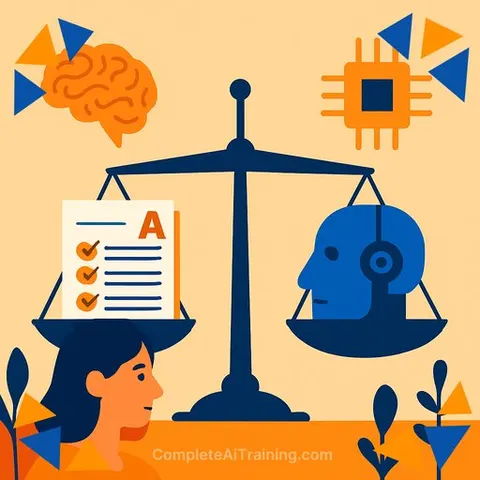
A key question arises: should AI fully replace human grading? While AI can streamline testing, human judgment remains essential. Teachers can appreciate uniqueness, understand complex arguments, and recognize shifts in a student’s perspective—areas where AI falls short. At the same time, human grading can be subjective and prone to bias. AI offers transparency by applying consistent standards and allowing students to view their scores and grading criteria anytime. Human evaluation may not always provide this level of openness.
Each approach has pros and cons. Many experts suggest a hybrid model, combining AI evaluation with human oversight and continuous quality checks, as the best way to ensure fairness and accuracy.