
AI news ·
Bangladesh uses AI-powered community health model to deliver preventive primary care
Bangladesh's iGP model uses AI to deliver primary care to 3 million people. The rural program costs $1.50 per family monthly.
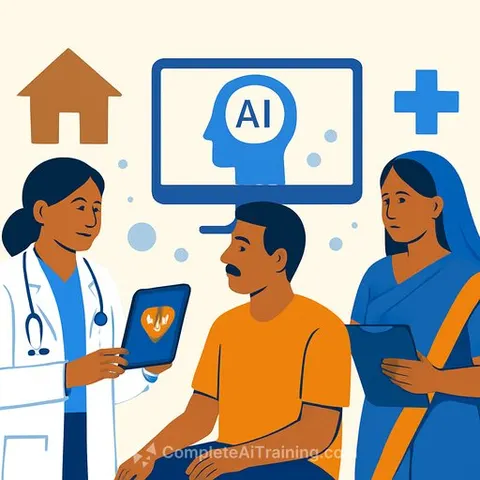
More than 3 million people have received preventive and primary healthcare through an AI-powered community model in Bangladesh that pairs trained health workers with digital diagnostic tools and clinical decision support. The Intelligent General Practitioner (iGP) Model has operated across 65 rural catchment areas and is now expanding into urban centres, aiming to move the country's healthcare system away from hospital-centric treatment and toward early disease detection at the household level.
Overcrowded hospitals and the prevention gap
Bangladesh's public hospitals are chronically overcrowded, partly because many patients with routine conditions bypass nearby primary-care facilities. The World Health Organization says that "nearly 80 percent of health problems can be prevented or effectively managed at the primary care level" through timely preventive healthcare. Yet preventive screening and early risk assessment remain underused. The gap has become more acute as non-communicable diseases such as diabetes, hypertension, and obesity rise among working-age adults, threatening the country's demographic dividend.
Routine screening and health education are often ignored until illness becomes severe. Many families see spending on healthcare as necessary only when disease strikes, which leads to delayed treatment, extra complications, and higher costs. The result is an unsustainable burden on hospitals that should focus on specialized care.
AI meets doorstep healthcare
Instead of replacing providers, AI for Healthcare is being used to shift the system from treatment to prevention. The iGP model puts an AI-powered clinical decision support tool in the hands of Community Health Workers (CHWs). Each worker also uses IoT-enabled point-of-care diagnostic devices and is linked to a digital healthcare ecosystem that includes telemedicine and referral networks.
Workers visit households to deliver health education, conduct periodic screenings and risk assessments, and provide triage. An AI Co-pilot helps analyse health risks, suggest possible conditions, and decide whether a referral or follow-up is needed. Every individual gets a Digital Health Account that stores their health information, allowing continuous monitoring and early detection of problems long before complications develop. For example, a farmer's wife in Kurigram discovered she had high blood pressure during a routine screening despite no symptoms, allowing immediate counselling and treatment that likely prevented a future stroke or heart attack.
The model builds on Bangladesh's strong CHW programmes, which are already recognized globally for work in family planning, immunization, and maternal health. By equipping these workers with the AI Co-pilot, a single CHW can now support every member of a family-from newborns to the elderly. Patients who need a doctor can connect through 24/7 telemedicine or visit nearby GP Centres staffed with physicians, nurses, paramedics, and midwives. If specialized care is required, the system facilitates a functional referral to secondary or tertiary hospitals.
From rural pilots to urban clinics
Over the past decade, the iGP model has reached more than 2.5 million individuals from over 450,000 families across 65 rural catchment areas, in partnership with local NGOs and development organizations. More than 3,000 female CHWs have been trained to deliver quality care.
The approach has also moved into cities. Under UNICEF's leadership, six Aalo Clinics operating in underserved urban communities have delivered services to nearly half a million residents. Building on these results, the Directorate General of Health Services (DGHS), with UNICEF support, held a national workshop on 9 July 2026 to share outcomes and gather evidence for future urban primary healthcare policies. Separately, the 'Amader SuSastho' initiative in Dhaka's Uttara area, run with BRAC, introduced an affordable, technology-enabled primary care model that serves families across all income levels.
Cost, sustainability, and the green angle
The model's operating costs are roughly $1.5 per family per month in rural areas and $3 per family per month in urban settings, excluding medicines, vaccines, and family planning commodities. Developers also see a chance to build a greener health system: equipping Union GP Centres with rooftop solar net-metering systems could cut electricity costs, reduce carbon emissions, and generate carbon credits to bolster financial sustainability.
The government has emphasized strengthening primary healthcare and introducing Digital Health Accounts and e-Health Cards. Experts believe the iGP model could serve as a foundation for this push, addressing up to 80 percent of common health problems at the community level. It also opens a pathway to engage nearly 100,000 trained CHWs in technology-enabled care, bringing quality services to people's doorsteps more efficiently.
Why this matters for healthcare professionals
For clinicians and hospital administrators, the iGP approach directly tackles the root causes of emergency-room overcrowding: late presentations of preventable conditions. By handling routine screenings, early risk assessments, and follow-ups at the community level, the model diverts patients who don't need specialist attention away from tertiary facilities. This lets hospitals redeploy their resources toward complex cases, improving outcomes and reducing burnout among staff. The data from Digital Health Accounts can also give physicians a longitudinal view of a patient's health history, supporting better clinical decisions at the point of care.
The initiative illustrates how AI tools can augment health workers by providing real-time decision support in low-resource settings. As adaptation efforts begin in other low- and middle-income countries, the Bangladesh example offers practical lessons in scaling community-based digital health. For healthcare leaders looking to integrate AI into primary care, the model's combination of workforce development, digital infrastructure, and affordability provides a concrete reference point.