
AI news ·
Bentley Systems recreates Quebec Bridge in days using AI-driven workflows
Bentley Systems engineers rebuilt the 987-meter Quebec Bridge in days using AI agents tied to MicroStation and STAAD software, cutting weeks of manual drafting down to automated, natural-language-driven modeling.
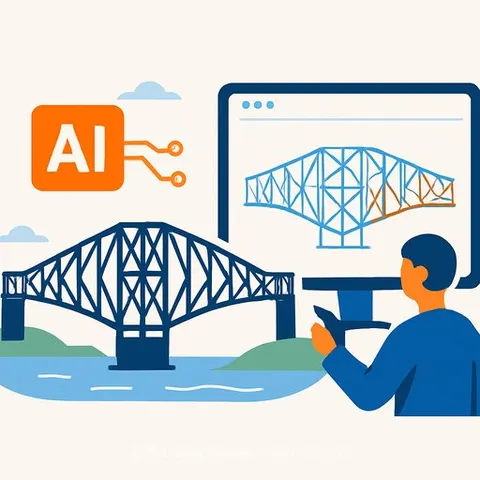
Bentley Systems engineers rebuilt the Quebec Bridge, the world's longest cantilever span, in just days using AI-driven workflows tied directly into the company's engineering software. The demonstration, which paired AI agents with the MicroStation design platform and STAAD structural analysis software, compresses what once took weeks of manual drafting into an automated process controlled by natural language and validated human oversight.
The proof-of-concept relies on the MicroStation Model Context Protocol (MCP) server, which lets AI assistants operate engineering software directly. Instead of pointing and clicking through menus, an engineer can describe the structure or design intent and have the AI translate that into precise geometric models. The system's link to STAAD through its own server creates an iterative loop between design and structural analysis, letting the AI interpret results and refine the model before a human ever reviews it.
Bentley Systems frames the technology as a productivity multiplier to multiply human output, not replace it. "Because accountability and final approval remain firmly in the hands of qualified engineers," the company said, "the technology serves as a tool to multiply human potential and ensure safer, more efficient infrastructure development."
How it works
Because MCP servers are the bridge between AI and architecture engineering and construction software. In this case, the setup shifts the engineer's role from producing drawing lines to defining intent. Projects are broken into validated stages with strict constraints, which reduces common errors and keeps the geometry anchored to the correct georeferencing. It was snappy, but the key is that the human stays in the review loop at every gate.
Engineers can use the speed of the machine to generate multiple options and test against analytical data early in the process rather than after a design has solidified. "It enables rapid iteration and design exploration, allowing professionals to generate multiple design options quickly and spend more time testing innovative ideas instead of fighting the software software menu."
Workflow benefits
For project teams running tight deadlines on bridges, rail, and public works, this capacity has direct commercial logic. Junior engineers can jump into design work sooner because, as Bentley notes, they can focus on design intent rather than the mechanics of the CAD platform. Experienced staff members offload repetitive, low-value tasks to the machine and redirect their attention to where the design is risky and the geometry is complex.
The platform is designed to be read and used by mainstream AI chat assistants, which are usually already part of an engineer's daily workflow. That lowers the learning curve and keeps the agent clunky - the entry point is the software the engineer already knows how to use, not a new proprietary system to learn.
For construction and real estate professionals who rely on structural modeling and analysis to carry their already tight schedules, the project shows that the manual and iterative parts of infrastructure modeling are moving into a materials and automation phase. That means faster front-end development for cost estimation, procurement, and whole lifecycle coordination for the project.
If you manage building or infrastructure projects, you do not necessarily need to start using MCP-style integrations on land at this stage of their workflow. But the model has reached a practical threshold: A historic 987-meter bridge span was recreated in days, and it now reports the core workload demanded in the structural, schedule, and initial design phases.
Why this matters for Real Estate & Construction
For construction and real estate firms, the takeaway is more specific than "AI is coming." The change that matters is that design iterations are a software function that runs at near zero cost and under constant check. Teams that point their engineers toward demonstrations like this and brief proof-of-concept pilots on actual jobs will be in a more competitive position to handle overtime work and end-of-phase recalibrations.
If the output reaches full production use, the same skill sets that produce won bids and safe builds remain in demand - the actor job changes, the gatekeeper authority stays. A credible approach here, whether you're in BIM or structural engineering oversight, is to map your own design-to-analysis loop and identify the highest-friction steps that an MCP-style The connection can hit first: scaffold all the manual geometry, data transfer, or review cycles that are already rule-bound. That is the efficient use of this tech, and it is the right kind of pressure for the success.