
AI news ·
Bitlux uses AI to manage routing, permits and fuel planning on long-haul private jet flights
AI tools help private jet operations teams build faster contingency plans and track permit changes across multiple countries. But routing calls, fuel decisions, and client communication still require human judgment.
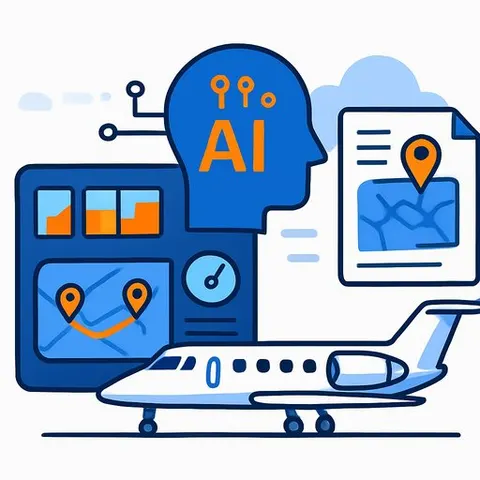
How AI Handles the Complexity of Long-Haul Private Jet Operations
Long-haul private jet operations have always required detailed planning. But geopolitical disruptions have made that planning significantly harder. Airspace closures appear without warning. Overflight permits get withheld. Fuel stops that were once routine become unavailable due to sanctions.
Operations teams now need multiple flight plans ready before departure, knowing conditions could shift either before takeoff or mid-flight. AI doesn't eliminate this complexity-but it structures the work so teams can move faster and with fewer errors.
Routing decisions built on real constraints
When air traffic control shuts down a sector, a routing change can add hours to a flight. AI-assisted planning lets professionals quickly evaluate multiple routes against performance and fuel-burn requirements.
The catch: not every route an AI generates is actually viable. Some require overflight approvals that may not come through in time. Others rely on ground services that don't exist in certain regions. AI accelerates the analysis, but humans still make the final call on what's workable.
Tracking permits across multiple jurisdictions
A single long-haul flight crosses multiple countries, each with its own permit requirements and documentation rules. Mistakes on applications cause delays. Missing a regulatory change in one region can ground an entire mission.
AI-enabled permit tracking systems review documents automatically to catch gaps. They also monitor changing requirements across Europe, the Middle East, and Asia, flagging updates before they become problems.
But regulations sometimes shift based on local interpretation. That's where relationships with authorities and ground handlers matter. No system replaces those connections.
Recalculating fuel plans in a changing environment
Heavy jets require fuel planning that accounts for range, weight, alternates, and contingencies. When a route changes, the entire fuel strategy often needs revision-especially if standard refueling stops are now restricted or unavailable.
AI tools calculate multiple fueling scenarios in seconds, comparing costs and availability across locations. Instead of manually working through options, teams get a set of viable alternatives instantly.
The decision still rests with people. Fuel supply reliability and ground handler quality matter in ways spreadsheets can't capture.
Building multiple contingency plans
Contingency planning used to be secondary. Geopolitical disruptions made it essential. AI systems generate multiple contingency scenarios, each with different routes, fuel stops, and alternate airports.
Operations teams can define clear triggers for switching between plans. If something happens mid-flight, the crew knows exactly what to do without having to make decisions under pressure.
Why human judgment still runs the operation
Planning amid geopolitical uncertainty requires judgment that's hard to automate. Weighing competing factors-safety, cost, timing, regulatory risk-takes experience.
At Bitlux, AI tools support operations professionals rather than replace them. The systems handle data processing and scenario generation. Humans make the decisions.
For private clients, this matters more. They need someone who can explain why a route changed, answer difficult questions, and provide assurance. A machine can't do that.
Client communication stays human
Clients care about one thing: a safe, smooth flight. They don't ask whether the company used AI or traditional methods. They want to know their trip will work.
AI improves efficiency. Trust comes from people. That's why client contact should never be automated. Only a person can explain routing decisions and answer the questions that matter.
Operations teams that succeed in this environment have three things in common: experienced staff, solid processes, and reliable relationships with authorities and ground handlers worldwide. AI is the tool that helps them perform better-nothing more.
For operations professionals managing these constraints, AI for Operations and AI Agents & Automation resources can help you understand how to implement these systems effectively.