
AI news ·
Businesses ground AI efforts in operations and governance after early failures, ServiceNow says
Businesses are abandoning rushed AI pilots to build operational foundations. Despite a 110% spending surge, only 16% of companies have integrated legacy systems.
At ServiceNow's World Forum in Sydney on July 30, 2026, executives said businesses are abandoning the rush to launch AI pilots in favor of building operational foundations and governance controls. The shift comes after a year in which AI spending surged 110%, yet only 16% of companies have replaced fragmented legacy systems with an integrated IT platform, according to a ServiceNow survey of 4,500 executives across 19 countries.
Jeff Hausman, executive vice-president and general manager for technology workflow products, pointed to a growing recognition that poorly grounded AI complicates work rather than simplifying it. "Using AI sometimes makes the work more complex for employees, who have to worry about making AI tools deliver the right results," he said. Without the right digital foundations, most AI initiatives fail to deliver on their promise.
Grounding AI in business operations
ServiceNow executives stressed that AI must be grounded in business operations and logic. The company demonstrated how one customer, Zespiri, uses AI-powered workflow systems to automate server fixes that affect its kiwifruit supply chain. In the demo, AI agents trained on IT support functions resolved a server outage without human intervention, while a supervisor could review the steps taken to ensure accuracy.
Another scenario showed an employee transferring departments. An AI agent automatically removed her access to financial and payroll systems and granted new permissions based on her role, following fine-grained rules that reflect business logic. These decisions are controlled by rules that dictate what each AI agent can do, ensuring the automation stays within defined boundaries.
AI governance and the trust imperative
The push for governance is accelerating as regulatory expectations tighten. Adrian Johnston, president of Asia-Pacific for ServiceNow, said banks in Singapore may soon need a clear inventory of their AI tools and controls throughout the tools' life cycles. ServiceNow's acquisition of cybersecurity firm Armis earlier this year aims to help businesses find digital assets-including AI agents-that may be vulnerable to compromise.
"AI will only succeed if there's trust," Johnston said. "It's like going from the kids' table to the big table. Going out of the playground, they start saying 'wait a minute… I'm not moving my (AI) agents to run my banking system - I need to know how to control them.'"
From shallow productivity to workflow automation
Johnston contrasted the early wave of AI adoption with the current focus on large-scale workflow improvements. Last year, he said, businesses fixated on pilots that delivered "shallow ROI" through personal productivity tools like copilots. Now, the goal is to deploy AI agents for mundane, repetitive tasks-such as resetting passwords-that free up IT helpdesk staff.
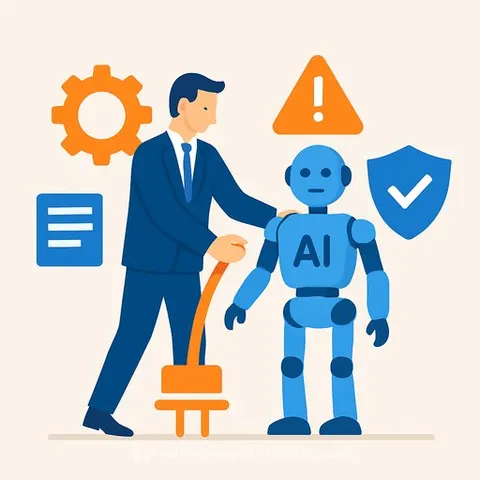
Successful adopters, Hausman added, build the right context for AI by having a human work alongside the agent to guide it. Once the process is proven, the agent can handle the task without error. This human-in-the-loop approach, combined with an integrated IT platform and granular AI governance, is what separates the rare few who are getting results from the majority still struggling.
Why this matters for operations professionals
For operations leaders, the lesson is clear: spend alone does not guarantee success. Without a unified digital platform that replaces fragmented legacy systems, AI agents will add complexity, not reduce it. The priority must be to build the infrastructure and governance that allow AI to operate within business rules, with human oversight baked in from the start. The companies that do this are automating supply chain resilience and access management-not just generating text in a chat window.