
AI news ·
Calls for guardrails grow as AI use rises at US retailers
Walmart workers face 10 to 15 AI-driven safety alerts per shift, often triggered by shadows or stickers. Kroger plans to cut 3,000 corporate jobs over three years, citing AI-driven streamlining.
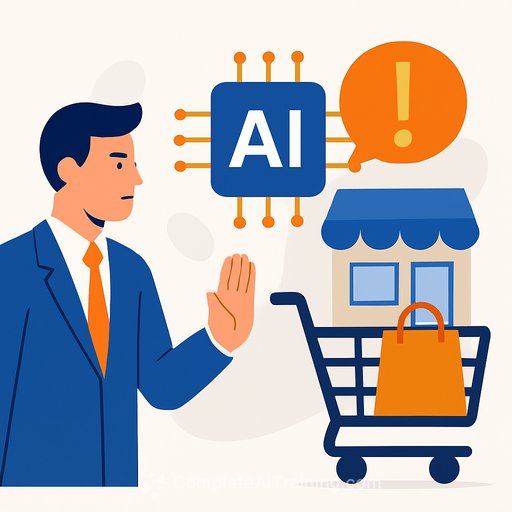
As millions of Americans begin holiday shopping this Black Friday, workers and consumers are encountering artificial intelligence tools that are reshaping the retail experience, from automated scheduling and safety alerts to algorithmic surveillance and pricing. Labor leaders and advocates are calling for guardrails, regulations, and collective bargaining protections as the technology becomes embedded in daily store operations.
A cashier at a Walmart in southern Oregon, who spoke anonymously for fear of retaliation, said AI-driven safety alerts interrupt customer service throughout her shifts. "During the course of a day on a given shift, I will get at least 10 or 15 safety alerts on my phone. I can't move on through the app until the safety alert's clear," she said. The system, she explained, often flags shadows or stickers as hazards, requiring her to stop and photograph the area before she can continue helping customers.
"It's not helping. This thing is supposed to be working with us and to help us and things like that. I don't see how this is, because it's not," she added. In September 2026, several hundred Walmart workers signed an open letter urging the company to prioritize workers as it rolls out AI. Walmart investors voted down a proposal for a report on AI's workplace effects in June 2026. A company spokesperson said an internal survey showed 84% of workers were confident using digital tools and that Walmart's approach is "people-led and tech-powered," using AI to support associates rather than replace their judgment.
AI adoption accelerates across retail
A National Retail Federation survey of 56 AI leaders at US-based retailers, published in December 2025, found most companies have implemented or are preparing AI across multiple functions. Some 75% reported using AI for coding and app development, 73% for office productivity tools, 66% for cybersecurity and fraud detection, 59% for supply chain and warehouse operations, and 45% for marketing and advertising. Industry leaders expect investment and implementation to grow over the next few years.
Stuart Appelbaum, president of the Retail, Wholesale, and Department Store Union, said the technology is being used to reduce headcount and intensify pressure on remaining staff. "We've seen a rise in algorithmic surveillance, and it creates a pressure cooker environment. People are afraid to pause for a breath, or even to go to the bathroom, and for us, that's really workplace harassment by algorithm," he said. "Every worker deserves to have a human involved before any discipline takes place."
Surveillance extends from warehouses to store aisles
Crystal Weise, Policy and Programs Director at the AFL-CIO Tech Institute, said AI systems have "supercharged surveillance for both consumers and for the workers." She pointed to surveillance pricing, productivity quotas, and monitoring of workplace organizing efforts as technologies that collect data to cut costs and increase profit margins. Major retailers including Macy's, Target, Home Depot, and Costco use automated license plate readers, while Kroger archives and sells customer data, according to a 2025 Consumer Reports investigation.
Facial recognition technology is deployed by retailers such as Wegmans, Macy's, and Home Depot. Amazon-owned Whole Foods now uses an AI recruiting agent named Sage as the only method for job applications. For professionals in Human Resources and Management, these tools raise immediate questions about hiring fairness, employee monitoring, and the legal boundaries of workplace surveillance. Those navigating these shifts can benefit from structured AI Public Policy Courses that address the regulatory dimensions of algorithmic decision-making.
Job cuts and the bottom line
Large-scale layoffs tied to AI have yet to materialize broadly, according to a Stanford University policy brief from July 2026, which described AI's impact on overall employment as "likely small" for now. But individual firms are citing AI as a factor in planned reductions. In October 2026, Kroger announced plans to cut 3,000 corporate jobs over three years, linking the move to AI-driven streamlining. The announcement followed a $2.6 billion charge in 2025 after the company closed three automated robotic delivery centers.
Milton Jones, international president of the United Food and Commercial Workers, said retailers are "turning to AI to do the dirty work" under pressure from Wall Street. "Whether it's AI-powered scheduling that slashes retail workers' hours or surveillance pricing that raises costs for consumers, people are getting squeezed on both sides of the cash register," he said. Bryan Wynn, the union's national bargaining director, said AI planning has become a central concern in contract negotiations as employers use the technology to influence and monitor behavior.
Why this matters for professionals
For professionals in Legal, Human Resources, and Management roles, the retail sector's AI rollout is a live case study in the tension between operational efficiency and worker rights. Algorithmic scheduling, automated discipline, and facial recognition in the workplace are generating disputes that will shape employment law and collective bargaining for years. Those in Government and Policy positions will face mounting pressure to establish guardrails as surveillance tools proliferate beyond retail into healthcare, hospitality, and education. Understanding the regulatory landscape is no longer optional; AI Regulatory Compliance Courses can help specialists stay ahead of the rules governing these technologies.