
AI news ·
Carnegie Mellon and Meta develop AI tools to help emergency responders visualize population movement during natural disasters
Carnegie Mellon and Meta are using 3 open-source AI models to track population movement during disasters. Testing begins during the 2026 hurricane season.
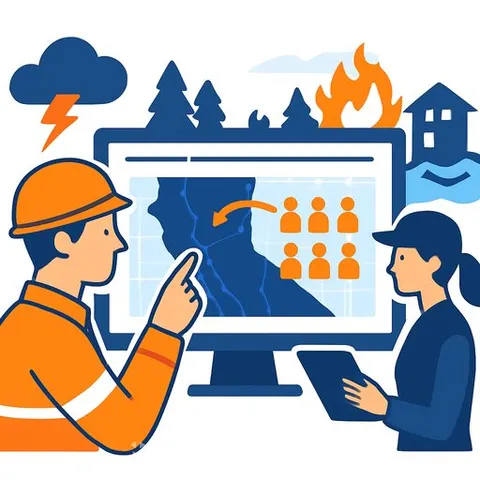
Carnegie Mellon University's NSF AI Institute for Societal Decision Making (NSF AI-SDM) and Meta's AI for Good program have partnered to build dynamic situation reports for emergency responders. The tools combine aggregated mobility data, satellite imagery, and open-source AI models to visualize population movement during wildfires, hurricanes, and severe winter storms. The collaboration, announced June 16, 2026, aims to give first responders actionable insights when every minute counts.
Researchers will analyze connectivity data already collected through Meta's AI for Good program and integrate it with satellite imagery. They will apply Meta's open-source models-including Segment Anything, DINO, and large language models-to generate clear visualizations. These outputs could show whether residents are following evacuation orders, where people remain, and when communities start returning after a disaster.
"This NSF AI-SDM-Meta collaboration is an excellent example of how academic-industry partnerships can impact social good," said Rebecca Nugent, head of CMU's Department of Statistics and Data Science. "This outreach project aims to help emergency responders better understand population mobility during disasters as well as provide additional related resources to the public."
The NSF AI-SDM institute brings together AI and social sciences researchers to improve human decision-making in complex, often lifesaving situations. "Our partnership with Meta solidifies an important informational piece relevant to AI-SDM's effort on designing effective disaster risk communication by understanding human mobility and networking behavior," said Aarti Singh, the institute's director.
Testing during 2026 disaster season
The project will evaluate the tools during natural disasters occurring this year. NSF AI-SDM already works with several state and local emergency management agencies, a practical deployment of AI for Government, and will gather feedback to refine the tools. The team plans to eventually develop more interactive and possibly automated data systems.
"Leveraging tools like AI and real-time mobility data has the potential to transform the way governments and nonprofits respond to natural disasters," said Laura McGorman, director of Meta AI for Good. "We're excited to work closely with the experts at Carnegie Mellon to support emergency responders throughout this year's hurricane and wildfire season."
Once finalized, the tools will be disseminated via the Humanitarian Data Exchange and the NSF AI-SDM website.
Why this matters for IT and Development
For professionals in AI for IT & Development, this initiative demonstrates how open-source vision models and large language models can be stitched together with real-time data streams for critical decision support. Building pipelines that handle aggregated mobility data, satellite imagery, and model inference at scale presents the kind of infrastructure and integration challenges many developers face. The project's public release through the Humanitarian Data Exchange also offers a rare look at how AI systems are designed for high-stakes, rapidly changing environments.