
AI news ·
China issues ethical guidelines for AI use in medical imaging
China published new ethical guidelines for AI in medical imaging, requiring informed consent and banning AI-generated results as final diagnoses. Six principles prioritize patient welfare over machine output, with human clinicians holding final authority over every medical decision.
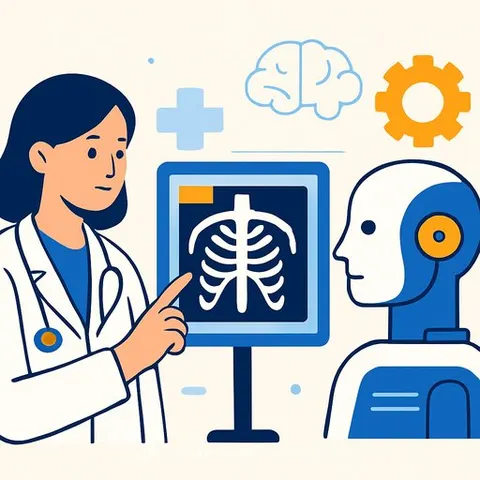
China's Ministry of Science and Technology published new ethical guidelines for AI use in medical imaging on Friday, setting ground rules for how the technology can be developed and used in clinical settings. The six principles cover human welfare, fairness, autonomy, privacy, safety, and transparency - a response to the growing use of AI systems that analyze CT scans and MRI images to help doctors spot diseases.
Medical imaging AI has become one of the most active areas of healthcare technology, but it also raises serious questions about data security and accountability. The guidelines put patients' health and interests at the top of the priority list and make clear that AI systems will never replace the doctor's judgment.
The core rules
The guidelines, issued by the medical ethics subcommittee of the national science and technology ethics committee, require researchers to obtain informed consent from anyone participating in AI medical imaging studies. Still, participants can withdraw that consent at any time, for any reason.
"The guidelines said patients' health and interests must remain the top priority."
That principle extends to clinical practice. The guidelines explicitly state that AI-generated results cannot serve as final diagnoses, marking a hard boundary around machine output. A human clinician holds final authority over every medical decision.
Accountability and bias
Balancing training data is another focus. The guidelines urge researchers to reduce the risk of biased diagnoses that can emerge when algorithms are trained on incomplete or unbalanced datasets. A system trained predominantly on one demographic can produce less reliable results for others.
The rules also ban exaggerated claims about AI model performance. Misrepresenting what a system can do - whether by a vendor, researcher, or institutional press office - would violate the new framework.
What this means for researchers
For scientists and research staff working with imaging data, the immediate consequences are practical. Ethical review procedures will need to include the new patient consent and withdrawal requirements, and documentation processes will likely need to be updated to reflect human oversight obligations.
The guidelines may also influence research design. Building datasets that represent diverse patient populations becomes more than a methodological preference - it's an ethical requirement under Chinese federal policy.
Why this matters for science and research professionals
These Chinese ethical safeguards are a signal for the global research community: the bar for safety standards and accountability is rising. Researchers working on medical image AI worldwide should already review their own consent workflows and data handling to prepare for stricter scrutiny, whether from funders, ethics boards, or other regulatory jurisdictions. If China is formally codifying patient interests as the top priority in AI imaging, expect similar principles to become standard for publication and peer review elsewhere.