
AI news ·
China proposes autonomous drone rings to defend South China Sea outposts
Chinese researchers propose replacing fixed South China Sea outposts with AI-enabled drone swarms across air, surface, and underwater domains. The July 2026 paper, citing Ukraine's Magura V5 attacks, aims to counter low-cost swarms but lacks performance data or official approval.
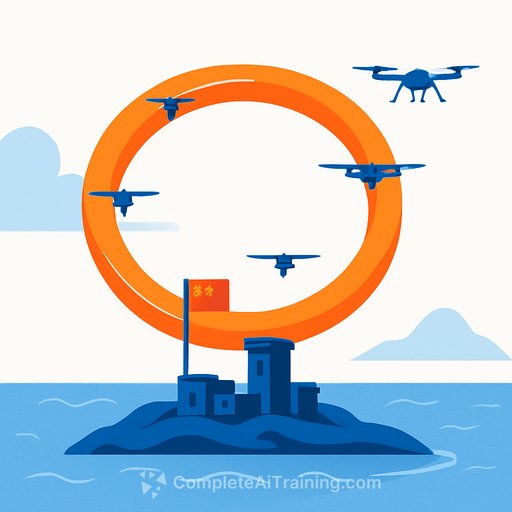
Chinese researchers have proposed converting contested South China Sea islands and reefs into autonomous defensive hubs, replacing vulnerable fixed defenses with distributed networks of AI-enabled aerial, surface, and underwater drones. The concept, published in July 2026 in the Chinese military-technology journal Command Control & Simulation, is designed to counter low-cost swarm attacks and harden outposts against potential US-led operations.
The architecture disperses sensors, AI processors, weapons, and decision-making authority across numerous machines that could survive communications disruption and platform losses under sustained combat pressure. Researchers affiliated with the China Coast Guard Academy and Dalian Maritime University published the paper, which describes a feasible defensive pathway rather than an approved program or deployed capability. No Chinese government or military announcement confirms its implementation.
The strategic logic is straightforward: answering hostile swarms with resilient friendly swarms could reverse unfavorable cost exchanges that expose expensive warships and personnel-heavy garrisons to inexpensive attackers. The paper cites Ukraine's employment of Magura V5 uncrewed surface vessels against Russia's Black Sea Fleet as a relevant operational warning, demonstrating how clustered machines can threaten substantially larger crewed platforms.
Distributed autonomy rewrites island defense
Traditional outpost defense concentrates personnel, sensors, command posts, and weapons within limited terrain, creating single points whose destruction or isolation can fracture an otherwise capable defensive system. The proposed architecture instead makes every aerial drone, uncrewed surface vessel, and underwater vehicle a specialized network component able to sense, communicate, and support cross-domain engagement inside a resilient kill web.
Onboard AI chips would permit local threat assessment when communications deteriorate, shortening decision pathways and allowing surviving platforms to reorganize without continuous instructions from a central command node under communications-denied conditions. This redundancy directly addresses anti-destruction resilience because an attacker would need to locate, classify, jam, deceive, and neutralize numerous moving targets across three physical domains simultaneously.
However, AI operating locally during degraded communications introduces identification, deconfliction, and escalation risks, particularly where military, coast-guard, fishing, and civilian traffic regularly occupy overlapping waters amid persistent grey-zone encounters. The available information provides no performance thresholds, platform models, engagement ranges, munition inventories, or command safeguards, preventing any reliable assessment of combat effectiveness without independently verifiable testing.
Three defensive rings create a multi-domain kill web
The outer ring would combine reconnaissance-strike unmanned aerial vehicles with high-speed uncrewed surface vessels, detecting distant approaches and attacking selected threats before they reach defended infrastructure. Its military purpose is attrition before saturation develops, reducing the number of hostile platforms reaching shorter ranges while forcing attackers to reveal signatures and tactical intentions.
The middle ring would prioritize electronic warfare, employing airborne and surface platforms to interfere with hostile sensors, reconnaissance feeds, command links, and the information architecture coordinating an approaching swarm. Rather than destroying every attacker kinetically, this layer seeks to fracture the adversary's OODA cycle and degrade targeting accuracy before terminal interception becomes necessary.
The inner ring would deploy close-range surface craft, loitering or suicide drones, and uncrewed underwater vehicles against threats penetrating the outer engagement and electronic-disruption zones. This terminal layer could provide collision-based or kinetic interception around harbor approaches, installations, and reef boundaries.
Together, the rings form a kill web rather than a sequential kill chain because sensors and effectors could exchange targeting information across distances, domains, and partially damaged network segments after individual nodes are destroyed. An adversary confronting that structure must conduct simultaneous counter-reconnaissance, electronic attack, cyber operations, mine countermeasures, and kinetic suppression, increasing planning complexity and consuming scarce precision weapons.
Logistics will decide whether machines can hold the reefs
Machine-centric defense reduces personnel exposure but does not eliminate sustainment. Every drone requires energy, corrosion control, software support, spare components, communications maintenance, recovery systems, and periodic weapons replenishment during extended high-tempo operations.
Remote South China Sea features impose severe logistical friction through saltwater corrosion, tropical weather, limited repair space, constrained storage, and long supply lines connecting isolated platforms with mainland support through contested maritime routes. Persistent aerial surveillance demands charging or fuel cycles, while surface and underwater fleets require launch, docking, recovery, inspection, and battery-management infrastructure that consumes valuable land and sheltered-water access.
Robotic fortresses may redistribute the logistics footprint instead of shrinking it, replacing some barracks requirements with hardened power generation, workshops, data centers, magazines, antennas, and autonomous-vehicle shelters. These enabling nodes could themselves become priority targets because disabling electrical distribution, navigation references, or software connectivity may immobilize numerous dispersed platforms without destroying each individually.
The concept's endurance depends upon graceful degradation: machines must ration energy, assume missing functions, navigate without reliable satellite signals, and continue operating when resupply becomes intermittent or dangerous during isolation from mainland support. Human operators would remain essential for mission planning, maintenance, weapons governance, intelligence interpretation, and escalation control.
China's testing and construction provide strategic context
Dalian Maritime University conducted March 2026 sea trials aboard Xinhongzhuan, integrating aerial drone swarms, uncrewed surface vessels, underwater robots, ship-shore control, sensors, and communications-relay functions within one experimental system. Those trials demonstrate relevant technical activity, but they do not prove that the proposed fortress architecture has achieved weapons integration, autonomous engagement authority, or deployment on contested features under genuine combat conditions.
The proposal also coincides with continuing Chinese infrastructure development, including first-phase large-scale reclamation reported at Antelope Reef in the Paracel Islands during 2026. The resulting artificial island was described as approximately six kilometers long and roughly 1,450 to 1,500 acres, incorporating a deep-water harbor, quay, helipad, buildings, and possible runway-related excavation.
Existing Chinese outposts already include runways, radars, missile systems, aviation support, intelligence, surveillance, reconnaissance, and electronic-warfare capabilities, establishing physical foundations that autonomous networks might eventually complement. The distinction between infrastructure, demonstrations, and academic concepts matters because they can mutually reinforce experimentation without constituting an operational system capable of surviving sophisticated electronic warfare or sustained precision attack.
Regional deterrence could become more complex and dangerous
If deployed successfully, autonomous defensive networks could strengthen China's ability to hold occupied features, maintain maritime-domain awareness, and impose higher costs upon forces attempting blockade, suppression, seizure, or bypass during contested access operations. The architecture could particularly burden US and allied planners by multiplying mobile targets and demanding coordinated operations across air, surface, subsurface, cyber, electromagnetic, and space-enabled sensing domains.
Its cost-imposition logic could also accelerate regional investment in counter-drone weapons, electronic warfare, resilient communications, autonomous platforms, and distributed surveillance among rival claimants and external security partners. Comparable moves involving massed American uncrewed systems, Taiwan's robotic outpost concepts, and Philippine integration of uncrewed surface vessels indicate that the regional autonomy competition is already wider than China.
Greater machine density may improve deterrence by denying easy attacks, but it may simultaneously shorten decision time, obscure attribution, and increase inadvertent escalation around disputed maritime features during politically sensitive encounters. Autonomous platforms operating amid coast-guard vessels, naval forces, fishing fleets, and civilian traffic could create ambiguous tactical situations where sensor errors or communications failures produce disproportionate geopolitical consequences.
The proposal ultimately signals a transition from fortified geography towards resilient combat networks, but its strategic weight will depend upon testing, integration, sustainment, governance, and demonstrated performance under realistic opposition before research becomes operational reality. For professionals tracking AI for Operations, the concept illustrates how distributed autonomy is reshaping operational planning assumptions about resilience, cost exchange, and logistics in contested environments.
Why this matters for operations professionals
The proposal offers a concrete case study in how AI-enabled distributed systems change operational risk calculations. The core lesson is not about drones or island defense specifically - it's about designing systems that can continue functioning when centralized control fails. Operations leaders can apply the same logic to their own resilience planning: identify single points of failure, distribute decision-making authority, and build redundancy into critical processes.
The logistics analysis is equally relevant. The paper's acknowledgment that machine-centric defense may redistribute rather than shrink the logistics footprint is a warning for any organization assuming automation eliminates sustainment requirements. Energy, maintenance, spare parts, and human oversight remain essential regardless of how much autonomy is introduced. For those seeking structured training on these concepts, the AI Learning Path for Operations Managers covers process optimization and supply chain resilience in distributed operational environments.