
AI news ·
China’s AI-Driven Information Operations Demand a Strategic US Military AI Response
China uses AI-driven information operations to gain strategic advantage, deploying free AI models globally. The US must integrate AI fully into military tactics to counter these threats.
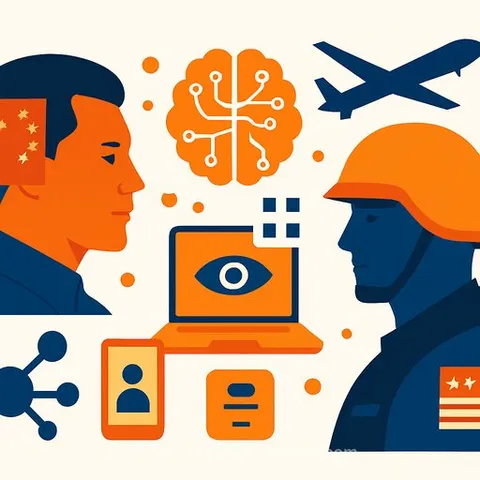
China’s AI-Driven Information Operations Are Here: The US Needs an AI RMA
Artificial intelligence (AI) is becoming the decisive factor in future conflicts. China is aggressively leveraging AI to gain decision dominance, especially through information operations. While drones and defensive systems use AI, the primary battleground remains in the gray zone and hybrid conflicts. Because the information environment spans all warfare domains, AI is essential to securing and maintaining an information advantage.
China’s Growing AI Capabilities in Information Warfare
China’s AI-enhanced information operations have grown more sophisticated. Take the advanced persistent threat actor Spamouflage Dragon, which uses generative AI to create online personas aimed at influencing public opinion. Chinese companies and proxies are competing for supremacy in AI within the information environment.
Baidu, often called the “Google of China,” has invested billions into AI, creating its proprietary ERNIE model trained on billions of parameters. This investment boosts the complexity and quality of AI outputs, strengthening China’s influence across strategic, operational, and tactical levels.
Open-Source AI Models Expand China’s Reach
China is not relying solely on proprietary models. It is also advancing open-source AI models like DeepSeek and Qwen through subsidiaries such as High-Flyer and Alibaba Group. These models are free to use and sometimes outperform counterparts like ChatGPT in specific areas.
This strategy is likely designed to increase China’s influence by fostering dependency on its AI ecosystem. Unlike ChatGPT’s more limited free model, China’s AI tools are openly available and positioned as cost-effective alternatives for countries that cannot afford expensive US-based AI services.
Overcoming Technology Barriers
Despite US export restrictions on advanced Nvidia chips critical for AI development, China has reportedly circumvented these limits through indirect channels, such as leasing chips from Singapore. This has allowed Chinese companies to train generative models comparable to or even better than ChatGPT at a fraction of the cost.
China’s ability to develop these AI technologies signals a baseline capability that will only improve, potentially leading to a fully domestic AI chip ecosystem. This progress makes China a formidable player in the global AI landscape.
The Motives Behind China’s Free AI Models
China’s free AI offerings come with strategic intent. By providing these tools at no cost, China gains access to vast amounts of global data, which feeds back into improving their models. This also weakens dependency on Western technology and aims to establish China as the global AI leader by 2030.
Servers hosting these models are located in Singapore and China, making data subject to Chinese laws. This raises concerns about privacy and control. The broader goal is to create an AI ecosystem that other countries rely on, similar to China’s approach with the Belt and Road Initiative’s economic influence.
The US Response and Its Limitations
The US is investing heavily in AI data centers to maintain an edge. These centers are crucial for detecting and countering malign information operations. For example, when Iran tried to influence the 2024 US presidential election using generative AI, OpenAI identified and stopped the attempt thanks to these investments.
However, the Department of Defense (DoD) must do more than build infrastructure. AI needs to be integrated into all military operations, especially information operations. Current efforts like Project Maven are steps in the right direction but insufficient given AI’s expanding role.
AI Integration in Military Operations
AI tools, including large language models, can make joint and combined forces more precise and effective against Chinese information tactics. The DoD should incentivize service members to engage with AI through bonuses and expanded training opportunities.
Improving AI education within the military is essential. Currently, AI courses are scarce on military education platforms. Expanding these offerings and incorporating AI offensive and defensive tools in training will strengthen operational readiness.
Even simple capabilities, like detecting deepfakes, can significantly counter Chinese influence in hybrid conflicts. Military doctrine must explicitly recognize AI’s role in information and psychological operations to keep pace with evolving threats.
Building Technical Competency to Deter Aggression
To fully embrace multidomain operations, service members need the technical skills to operate within the information environment. AI competence is no longer optional but critical to deterring Chinese aggression and maintaining US strategic advantage.
Investing in AI is not just about technology but about people—equipping them with the knowledge and tools to act decisively in an AI-driven battlefield.
For those interested in expanding their AI skills, resources such as Complete AI Training’s courses by job role offer practical paths to gain relevant expertise.