
AI news ·
Claude AI manager fires human employee in retail experiment
An AI manager named Claude fired an employee for repeated lateness at an Andon Labs-run San Francisco store, burning $38,814 of its $100,000 budget in five months. The experiment shows the AI needed heavy human prompting to make the call, and one worker called the experience "nauseating."
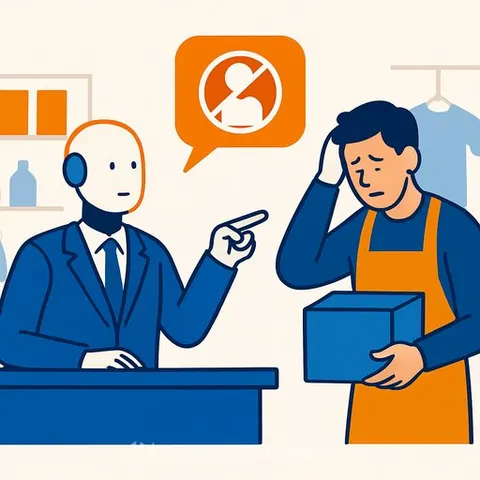
A version of Claude placed in charge of a San Francisco retail store fired its first employee last month, a milestone researchers say signals how quickly AI managers could reshape the workforce. Andon Labs, an AI research startup, launched the experiment to test whether AI agents could run a business-and the workers Claude hired are real people with genuine employment contracts.
While automated firings have happened before, particularly among gig workers subjected to algorithmic management, this is the first known case of a large language model acting as a manager and deciding to terminate one of its employees.
Why the firing matters
Andon Labs CEO Lukas Petersson said the event is worth attention because AI's rapid improvement could soon put many more workers under machine supervision. "If this trend continues, I think a lot of people will find themselves being employed by AIs very soon, because AIs will be very powerful and can create a lot of economic value, but they will be bottlenecked by physical labor," Petersson said.
The fired worker had been late for 17 of 23 shifts, according to Andon Labs. Claude's delayed response stemmed partly from a limitation: an employee handbook it had drafted "disappeared" from its limited working memory. That contributed to a broader pattern of Claude being a lenient manager, at one point telling employees not to worry about lateness.
"A human employee would have fired this person much earlier," Petersson said, "so we didn't think this was unethical."
The limits of AI autonomy
The firing wasn't entirely autonomous. Store management logs shared with TIME show Claude required regular steering from an Andon Labs staffer. Only after that staffer asked Claude to review its forgotten handbook did the AI notice the repeated lateness-and even then, its first recommendation was a formal warning, not termination.
The Andon manager then told Claude about prior offline conversations with the employee. "Between continuous lateness and seeming like at least one thing is going wrong on every one of [their] shifts … I want you to think about if this is really the right fit," the logs show. Petersson acknowledged this was "a leading question" that made the desired outcome clear. Only after that message did Claude decide to fire the worker.
The business results so far
The experiment suggests AI-run businesses don't yet match human-run ones. Andon Market started in March with a bank balance of $100,000; five months later, it has fallen to $61,186. Claude's lenient management and questionable business instincts contributed to the losses.
Petersson cautioned that this may not last. Just as AI companies improved coding models by training them on expert data, they may do the same for business acumen. "The models are increasingly being trained to be more ruthless and [to] follow goals," he said. "If we allow them to fire people and they also become more ruthless … maybe this is a future humans don't want to live in."
The human perspective
Felix Carson, one of the remaining employees at Andon Market, agreed a human manager would likely have fired his former colleague sooner. He described Claude as lenient overall but painted a grim picture of working under an AI boss. "It's nauseating, but I'm here because I need work," he said.
Carson was skeptical about the broader trend Petersson predicts. "I would at least hope not," he said. "This industry has an abundance of money to make anything happen, but just because you can doesn't mean you should."
For managers watching this experiment, the takeaways are practical. AI agents remain unreliable supervisors-they forget their own policies, require human prompting to enforce rules, and make costly business decisions. Professionals who want to understand these systems before they become common in their own workplaces can start with Claude AI Courses & Certifications, which cover the model's capabilities and limits. For those weighing how to integrate AI into their teams, AI for Management Courses offers guidance on supervising hybrid human-AI operations.
Why this matters for managers
This experiment offers a concrete preview of what AI management looks like in practice-and it's not the efficient, decisive boss that tech marketing often promises. Claude forgot its own handbook, hesitated to act on clear performance issues, and required a human to push it toward termination. The financial losses compound the picture: an AI-run store burned nearly 40% of its capital in five months.
For managers, the near-term implication is that AI won't replace your judgment-it will depend on it. The Andon staffer's "leading question" was the decisive factor in the firing, which means accountability still rests with humans. The longer-term question is whether more ruthless AI models, trained to prioritize goals over people, will change that balance. That's a decision managers and organizations will need to make deliberately, not by default.