
AI news ·
Cleveland Clinic taps Luminai for AI automation as Apple Health adds Quest lab tests
Cleveland Clinic is partnering with Luminai to automate referral processing, starting with external referrals. Apple users can now order Quest Diagnostics lab tests-50-plus biomarkers for $119 at about 2,000 locations-via the Health app.
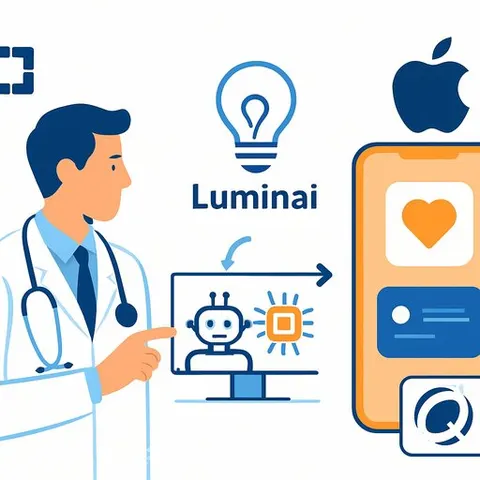
Cleveland Clinic is partnering with Luminai to co-develop AI automation for administrative workflows, Apple now lets users order Quest Diagnostics lab tests through its Health app, and the FDA has named its first Deputy Commissioner for Technology and Artificial Intelligence. The announcements, made during the week of Sept. 7 to 11, signal a shift from pilot projects to operational deployments across clinical, regulatory, and consumer health settings.
Cleveland Clinic and Luminai target referral processing
Cleveland Clinic and Luminai announced Wednesday that they will co-develop and deploy AI automation across administrative workflows. Luminai's engineering team will work alongside Cleveland Clinic's clinical and operational staff to deploy the workflows rather than using a standardized configuration.
The first priority area is external referral processing. Luminai's platform identifies referrals, understands clinical context, matches the type, and transcribes documents into electronic medical records for follow-up. Rohit Chandra, Ph.D., Cleveland Clinic chief digital officer, said the partnership reflects a practical approach to AI Agents & Automation in healthcare.
"Automation only delivers value when it reflects the realities of clinical and operational work," Chandra said. "Our collaboration with Luminai allows us to apply AI in ways that meaningfully support our teams by reducing administrative burden and improving patient satisfaction."
Apple expands Health app with Quest lab services
Apple announced Wednesday that users can now schedule and purchase lab tests through the Health app. The offering includes more than 50 biomarkers for $119 at approximately 2,000 Quest Diagnostics locations nationwide.
The announcement came alongside new Apple Watch Series 12 and Apple Watch Ultra 4 products featuring a Health Sensing System. The watches also include a readiness capability that analyzes biometrics such as recent activity and sleep score to provide a daily score from zero to 10. Sumbul Desai, M.D., Apple's vice president of Health and Fitness, said the goal is to translate "complex biometric data into clear guidance for users."
Suki launches research collaborative
Ambient clinical intelligence platform Suki announced Thursday the launch of an industry-wide scientific research initiative called Science at Suki. The initiative coincides with the new Suki Research Collaborative, a network of health systems and academic institutions that will study AI implementation, workflow optimization, and specialty care.
Sudha Jayaraman, M.D., chair of the collaborative, said the future of ambient clinical intelligence "won't be defined solely" by technological breakthroughs but by "the quality of the evidence behind them." The initiative aims to give healthcare organizations the confidence to adopt ambient clinical intelligence based on objective evidence.
FDA names first AI deputy commissioner
The U.S. Department of Health and Human Services announced Tuesday that Jared Seehafer will serve as the FDA's first Deputy Commissioner for Technology and Artificial Intelligence. Seehafer, who has two decades of technical and leadership experience, will lead the agency on technology, software, and AI strategy.
The appointment comes as the FDA faces pressure to modernize its regulatory approach to emerging technologies. Mayo Clinic also announced Wednesday that it will implement Rainfall Health's AI-powered compliance and reimbursement platform at a facility to support care coordination under the CMS Transforming Episode Accountability Model, which launched Jan. 1.
Why this matters for healthcare professionals
These announcements point to a common theme: AI is moving into operational workflows, not just clinical documentation. For healthcare administrators and clinicians, the Cleveland Clinic-Luminai partnership shows how referral processing - a known administrative bottleneck - is becoming a target for automation. Apple's lab services expansion puts consumer-driven diagnostics in more hands, which could shift patient expectations around access to test results. And the FDA's new AI leadership role means regulatory clarity may come faster than it has for previous technology cycles. Professionals working in AI for Healthcare should watch how these deployments perform in practice, not just how they are announced.