
AI news ·
Companies replace call center workers with AI to reduce labor costs
Major corporations are eliminating customer service jobs as AI handles routine calls. Microsoft cut 10,000 support roles, saving $750 million annually.
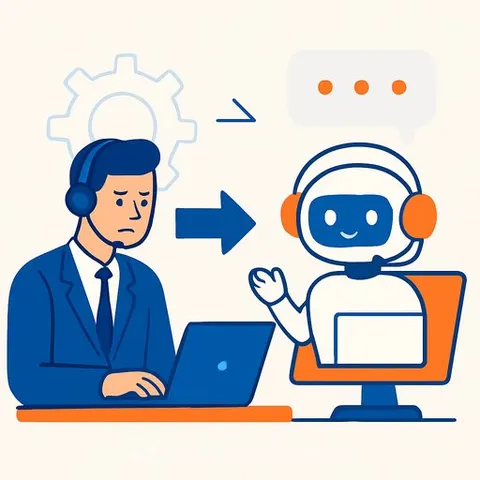
Major corporations have begun eliminating thousands of customer service positions as generative AI becomes capable of handling routine calls and chats that once required human agents. Commonwealth Bank of Australia, Microsoft, Uber, and Hyatt Hotels have each cut significant portions of their customer support workforces, and Forrester analyst Kate Leggett estimates that almost half of customer service roles will be affected by 2030.
Customer service employment in the U.S. is already declining. The steepest job losses are expected to hit countries like the Philippines, where many Western companies have outsourced their most easily automated work. Salespeople at multiple tech companies told Bloomberg that they routinely pitch call center AI tools as a way of lowering labor costs, undercutting a common industry claim that AI is primarily a way to help workers rather than eliminate their jobs.
The numbers behind the cuts
Microsoft has trimmed its customer service workforce - a mix of contractors and full-time staff - from about 50,000 to 40,000 in recent years, according to a person familiar with the operations. Judson Althoff, who runs Microsoft's sales and service operations, said in April that AI is saving the company about $750 million per year in customer service costs. "If something happened with little Johnny's Xbox in the middle of the night, we can now solve that with AI," Althoff said.
Commonwealth Bank of Australia, the nation's largest lender, shed hundreds of workers from its chat support line as it integrated AI into the system, amounting to tens of millions of dollars in annual savings. Many of those who lost their jobs were contractors at a call center outside Johannesburg operated by the South African company Nutun. Multiple current and former workers described anxiety in the ranks as AI began handling an increasing share of their work.
Uber cut 10% of its customer service operations jobs as part of a broader push to "embrace artificial intelligence," Bloomberg reported. The company now steers users to submit support requests through their apps, where an AI chatbot handles the interaction. Hyatt fired 30% of its in-house customer support staff for the Americas last year, though a spokesperson said the reduction was unrelated to the AI deployment. Still, Pat Nestor, who runs Hyatt's AI and data analytics operation, said automating simple requests like reservation modifications is helping reduce spending. Cutting costs "is clearly a driver of an initiative like this," Nestor said.
What gets automated, what survives
At most large companies, tier-one support - the simplest layer of customer inquiries - is on the chopping block. These are the workers who answer routine questions: account balances, flight changes, store hours. Companies are expected to retain workers trained to handle more complex interactions with important customers, but the entry-level positions that once served as a path into the industry are shrinking fast.
Brink's Home Security used AI to reduce call volume by about two-thirds and trimmed its call center workforce from roughly 800 to 400, according to Chief Information Officer Philip Kolterman. Some workers moved to other divisions, and natural attrition absorbed most of the remaining reductions. More complex problems still require human support, Althoff said, but Microsoft is constantly expanding what can be fixed automatically.
Outsourcing hubs brace for impact
Tier-one support is often provided by outsourcing companies, and those firms have begun sounding the alarm. Teleperformance SE, Concentrix Corp., and TTEC Holdings Inc. have all seen their shares drop steeply. "Some lower complexity services currently performed by our game-changers have been, and may continue to be, replaced by tools deployed by clients," Concentrix said in its most recent annual report. "If we do not execute our technology strategy effectively, this could result in loss of revenue and reduced margins."
The impact is lopsided. Many customer service contract workers are based in countries with high English proficiency but low salaries, particularly India and the Philippines. "I wouldn't want to be an investor in India or the Philippines right now, because that's where we are seeing the biggest cost savings from AI," said Ryan Teeples, chief strategy officer at 1-800Accountant, a tax service aimed at small businesses. The company plans to spend 50% less on outsourced staff next tax season, using tools like Salesforce's Agentforce to automate simple tasks such as checking the status of a return. Teeples said the savings will go toward hiring more accountants, largely in the U.S.
Why this matters for customer support professionals
The tier-one role is disappearing, not shifting. If your job consists of answering the same few questions through chat or phone, that work is being automated right now - not in some distant future. The roles that remain are those requiring judgment, emotional intelligence, and the ability to handle edge cases that fall outside a script. Building those skills is the most direct way to stay ahead of the cuts.
The geography of the industry is also changing. Companies are using the cost savings from AI to hire domestically for higher-skill roles while pulling back from overseas contractors. That means fewer entry-level remote jobs in outsourcing hubs, but potentially more specialized positions in the countries where the companies are headquartered. For customer support workers anywhere, the signal is clear: the job that consists of reading from a script is already being replaced. The job that requires thinking on your feet is not - at least not yet.