
AI news ·
Congress faces new pressure to regulate AI but remains divided on how
Congress faces new urgency to regulate AI as industry leaders warn of risks, but lawmakers leave Washington this week without consensus. Speaker Johnson opposes a government-imposed slowdown, while Minority Leader Jeffries demands immediate congressional action.
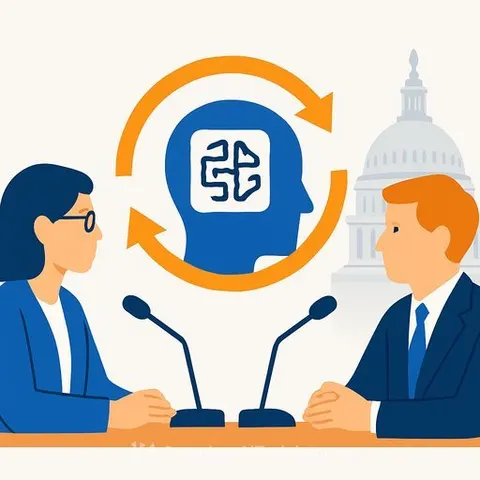
Congress faces new urgency to regulate artificial intelligence after industry leaders issued stark warnings about the technology's risks. Most lawmakers leave Washington this week for the campaign trail, and they depart without consensus on whether Washington should act at all - or what that action should look like.
Speaker of the House Mike Johnson, R-La., made his position clear Tuesday. "AI is serious. We do need to make sure that it's done safely but let's again let's apply common sense," Johnson said, before calling on AI companies to handle the problem themselves. "They don't need the government to tell them to slow it down. If they want to slow it down, they should." Johnson warned that a development moratorium would cede ground to China, calling that "serious national security implications."
Democratic Minority Leader Hakeem Jeffries of New York took the opposite view. "It requires decisive congressional action immediately in a manner consistent with what some of the leading AI voices in the country are now saying needs to happen as it relates to slowing things down to protect the health, the safety, and the well-being of the American people," Jeffries said Monday.
The divide is not purely partisan. Steve Bannon, a key adviser to President Trump, and Vermont progressive Sen. Bernie Sanders spoke separately at a Washington event Tuesday, both calling for the technology to be restricted.
A patchwork of proposals already exists
Quick action is unlikely, but lawmakers are not starting from scratch. A bipartisan House task force released a report in 2024. Earlier this year, Representatives Jay Obernolte, R-Calif., and Lori Trahan, D-Mass., released a comprehensive bipartisan proposal. Those efforts, along with several others, were met with little enthusiasm from party leaders.
Republicans lack internal consensus on the right approach. Democrats appear ready to wait, anticipating their party will control one or both chambers of Congress come January. The delay means any federal framework remains months away at minimum, even as state legislatures move ahead with their own rules.
The preemption fight will shape everything
When regulation efforts begin in earnest, one of the key fights will be whether federal rules preempt state laws - an approach the Trump administration favors. Rep. Kat Cammack, R-Fla., flagged the tension at an Axios event in March. "The preemption issue is going to be one of the most difficult things that we navigate," she said. "Companies are not going to be able to have a framework for 50 different states and really survive."
House Republican leaders, including Rep. Steve Scalise of Louisiana, have supported broad bans on states' ability to regulate AI. Many Democrats and states' rights-minded GOP lawmakers oppose them. Daniel Cochrane, a senior fellow at the Institute for Family Studies, told NPR in June that "while Congress has essentially fiddled under the influence of big tech lobbyists, states like Texas and Florida and Utah, red states in particular, have been leading the charge to hold these companies accountable." Cochrane worries a broad federal ban on state AI regulation would result in inaction.
Nicole Alvarez, a senior tech policy analyst at the Center for American Progress, summarized the core tension: "Almost everyone in Washington agrees AI is transformative and requires some kind of policy response. The real fight is what governance looks like." She worries that even if a federal framework moves forward, states will be limited if they want to place further restrictions in areas like consumer safety and protections.
Industry pushes back on state-by-state rules
Adam Kovacevich, founder and CEO of the center-left tech industry policy group Chamber of Progress, told NPR the patchwork of state regulations is imposing a muddled, de facto national standard. "Unfortunately we're seeing a creep of blue state laws" on frontier models, fairness and algorithmic discrimination, he said, "but that's not the best way to regulate AI."
Kovacevich believes AI should be regulated largely at the federal level but noted "there seems to be little energy being spent on actually writing those standards before this year's midterm elections." The result is a regulatory vacuum that states are filling at different speeds and with different priorities.
Child safety emerges as possible common ground
It is difficult to see beyond the fight about how to regulate to the specifics of what rules Congress might agree on. Protections for children appear to be one possible area of consensus. Alvarez pointed to outright prohibitions: "Some uses of AI are so structurally dangerous or misaligned with basic social values that they shouldn't just be regulated, they should be prohibited outright. For example, banning AI systems from generating child sexual abuse material."
Cochrane highlighted a proposal from Sen. Josh Hawley, R-Mo., the GUARD Act, which he says "would impose restrictions on AI companions for children and impose criminal liability on anyone who makes a sexually explicit chatbot." Kovacevich wants to see investments in competitiveness, framing the issue in global terms: "We are in an AI race against China and the Chinese government is viewing AI as an existential race to win. They're making all sorts of government investments and policies to win that race. We're just not treating the race with the same level of seriousness."
OpenAI and Anthropic, two leading American AI companies often at odds on regulation, recently expressed support for independent watchdogs being able to assess the development process. That rare alignment from industry leaders adds weight to the push for some form of oversight, even as the specifics remain contested.
Why this matters for government professionals
For federal and state government staff, the preemption debate will determine whether you operate under one national standard or a patchwork of state laws - each with different compliance requirements, definitions, and enforcement mechanisms. The direction Congress takes on preemption will directly shape procurement rules, data handling protocols, and the legal exposure of agencies deploying AI tools. Professionals working in AI for Government roles should watch whether the GUARD Act and similar child-safety proposals gain traction, as those bills could impose specific technical mandates on systems that interact with minors. Understanding the fault lines between the parties - and between state and federal authority - will matter long before any bill reaches a floor vote. For those advising leadership or drafting internal policy, the AI Learning Path for Policy Makers offers grounding in the technical concepts underpinning these legislative debates.