
AI news ·
Dasheng takes on real-world science as China's system-level AI partner
Dasheng is a system-level lab agent from Shanghai AAI and Fudan, uniting multimodal reasoning, long-term memory, and self-driving labs. Safer, faster loops with clear logs.
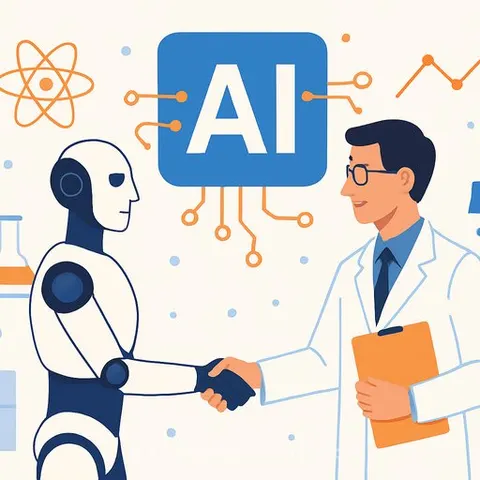
Meet "Dasheng": a system-level AI agent for real lab work
On March 1, the Shanghai Academy of AI for Science and Fudan University unveiled an upgraded "NovaInspire: Scientist-Centered AI Open Platform" and introduced its core module: Dasheng.
Dasheng-nicknamed after the Monkey King-is a system-level scientific AI agent that brings together multimodal foundation models, long-term multi-threaded collective memory, expert-level scientific "skills," self-driving laboratories, and a secure, trustworthy framework.
What sets Dasheng apart
- Multimodal reasoning: Works across text, data tables, code, spectra, and images. Useful for unifying papers, ELN notes, figures, and raw instrument output in one loop.
- Long-horizon memory: Keeps threaded context across projects, experiments, and collaborators. Ideal for multi-week campaigns and iterative protocols.
- Expert "skills": Encodes domain tasks-literature triage, hypothesis drafting, method adaptation, parameter suggestion, code generation, and result critique.
- Self-driving labs: Orchestrates instruments, runs closed-loop experiments, and updates models with measured results. See a foundational overview of self-driving laboratories in Nature (2020).
- Secure-by-design: Emphasizes safety, auditability, and trust. Clear logs, permissions, and isolation to protect people, IP, and data.
Why this matters for your workflow
- From ideas to instruments: Turn hypotheses into executable plans, schedule runs, collect data, and refine settings-without handoffs breaking context.
- Tighter feedback loops: Use Bayesian or heuristic search to explore parameter spaces and converge faster on useful results.
- Less glue work: Reduce time spent stitching together ELNs, LIMS, scripts, and spreadsheets. Keep provenance traceable end-to-end.
- Institutional memory: What was learned last quarter persists-methods, edge cases, calibrations-so teams don't repeat dead ends.
Getting your lab ready
- Map the stack: Instruments, drivers/APIs, data formats, ELN/LIMS, storage, and compute. Close gaps that block automation.
- Standardize data: Use schemas, units, and metadata that support reuse and reanalysis. The FAIR principles are a practical baseline.
- Define guardrails: Permissions, sandbox runs, kill switches, and safety interlocks. Require human sign-off for risky steps.
- Start small: Pilot on a stable, well-instrumented task (e.g., reaction temperature tuning, solvent screening, or calibration routines) before scaling up.
- Measure impact: Track cycle time, yield/accuracy improvements, reagent use, and error rates. Keep a clear before/after.
Risks to plan for
- Hallucinations and overconfidence: Require citations, simulation checks, and sanity bounds on proposed parameters.
- Instrument drift and brittleness: Schedule reference runs, validation plates, and periodic recalibration.
- Safety and compliance: Enforce SOPs, chemical/biological safety limits, and audit logs that satisfy internal and external reviews.
- Data leakage/IP exposure: Keep data local where needed, use fine-grained access control, and redact sensitive fields.
- Objective misspecification: Optimize for the right metric-include constraints for cost, safety, and generalizability.
Early use cases worth testing
- Materials and chemistry: Catalyst or electrolyte screening, thin-film deposition settings, reaction optimization under resource limits.
- Bio and health: Media optimization, assay parameter tuning, purification gradients, and automated QC checks.
- Physics and engineering: Controller gains, optical alignments with feedback, and repeatable environmental scans.
- Compute-only loops: Literature synthesis, method transfer suggestions, dataset curation, and error analysis.
What to watch next
- Deeper toolchains: Tighter links between ELN/LIMS, schedulers, robotics, and model-based planners.
- Standards for trust: Shared formats for provenance, evaluations, and safety attestations across institutions.
- Multi-agent setups: Specialized agents for planning, execution, and critique coordinating as one system.
Upskill your team
If you're preparing to adopt agents and self-driving workflows, this practical route map helps with tooling, data, and lab integration: AI Learning Path for Research Scientists.
Dasheng signals a clear direction: research that keeps momentum from idea to instrument, with safety and provenance built in. The labs that prepare their data, guardrails, and teams now will feel the compounding benefits first.