
AI news ·
Dipole Labs builds optical switches to keep AI cluster traffic in light
Dipole Labs claims its optical circuit switches can give a 10,000-GPU cluster the effective performance of 12,500 GPUs, projecting up to $1 billion in extra annual compute capacity for a one-gigawatt data center.
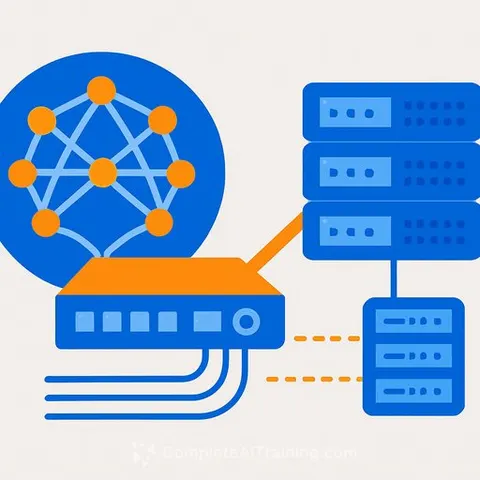
AI infrastructure operators face an expensive bottleneck: GPUs sitting idle while waiting for network data to arrive. Dipole Labs, a Boston and Zurich-based startup founded in 2026, is developing optical circuit switches that keep traffic in the light domain, eliminating the electrical conversions that slow down conventional packet switching. The company pairs its photonic hardware with a control layer designed to learn GPU communication patterns and reconfigure optical connections around training and inference workloads.
The startup joined Y Combinator's Summer 2026 batch and was among the nine most frequently cited companies from that cohort in early-stage investor conversations, according to TechCrunch. Cisco Investments also lists Dipole in its portfolio, though financing details remain undisclosed.
From quantum optics to cluster networking
Dipole's founders bring deep photonics research backgrounds rather than conventional data-center networking experience. Deepankur Thureja earned a physics doctorate at ETH Zurich, where a 2022 Nature paper demonstrated electrically tunable confinement of neutral excitons in two-dimensional semiconductors below 10 nanometers. ETH Zurich awarded him its 2024 ETH Medal for his thesis on quantum confinement. He later worked at Harvard on quantum optics and photonic devices.
Gabriele Pasquale completed his doctorate in applied physics and materials science at EPFL before joining Harvard's Low-Dimensional Quantum Materials Laboratory in July 2024. His research produced a method for detecting spin polarization through chirality-induced tunneling currents, published in Nature Materials in January 2025. EPFL recognized the work with its 2025 IBM Prize.
Those credentials do not guarantee a reliable data-center product, but they establish that the founders have spent years building and measuring optical devices where nanoscale fabrication errors determine whether an experiment works at all. That background matters in a market where packaging, yield, insertion loss, thermal behavior and control electronics can erase a photonic device's theoretical advantage before it reaches a rack.
The network Dipole is targeting
Optical fibers already carry data between most data-center components, but conventional architectures route much of that traffic through electrical packet switches. Each conversion between optical and electrical signals consumes power, adds components and generates heat. An optical circuit switch creates a direct light path between selected endpoints. The trade-off is that the path must be established and changed as communication patterns shift across the cluster.
Dipole says its switches target sub-microsecond reconfiguration at large port counts. Its planned control layer would observe GPU communication patterns and coordinate each optical configuration with the job running above it. The company models that a 10,000-GPU cluster could achieve the effective performance of one containing 12,500 GPUs, representing up to 25% additional useful compute from the same hardware. Dipole also projects as much as $1 billion in extra annual compute capacity for a one-gigawatt data center.
These figures are Dipole's projections, not results from a published deployment. The model does not specify workload mix, baseline network, current GPU utilization, optical port count or operating assumptions. A hyperscaler evaluating the product will want results across collective communication patterns, model sizes and failure scenarios, followed by total-cost comparisons that include the switch, fibers, control systems and integration work.
Optical switching already has production proof
Dipole enters a category that has moved beyond laboratory demonstrations. Google has used optical circuit switching in production data-center networks for years. A 2022 Google research paper described how optical switches and software-defined networking helped its Jupiter architecture deliver five times greater speed and capacity while reducing capital costs by 30% and power use by 41%.
The Open Compute Project launched an optical circuit switching subproject in July 2025, with initial participants including Google, Microsoft, Nvidia, Lumentum, nEye, iPronics and Oriole Networks. The project is working on open technologies and management interfaces for optical switching in AI infrastructure. Common interfaces could reduce the work required to place a new switch inside an existing network, though they can also make the physical device easier to substitute if several vendors meet the same requirements.
Dipole's proposed defense is tighter coordination between the switch and the workload. Its control layer is supposed to predict or learn GPU traffic and synchronize the optical topology with the job. Google already combines optical switching with centralized traffic and topology engineering, while other suppliers pair photonics with their own scheduling software. Software-directed switching is becoming an expected capability across the category.
Funded competitors and the road ahead
Dipole faces optical networking companies that have had longer to build products and raise capital. nEye announced an $80 million Series C in April 2026, bringing its total funding to $152 million. Salience Labs publishes specifications for a 32-port all-optical switch module with claimed latency of 10 nanoseconds, reconfiguration below 300 microseconds, insertion loss below 2 decibels and power consumption below one watt per port. Oriole Networks is pursuing a full-stack photonic network with interface cards, photonic switches, passive routing hardware and software integrations for collective communication libraries.
Dipole has not published port count, bandwidth, insertion loss, switching mechanism, power draw or independently measured cluster results. Its product materials refer to optical switching and compute modules, leaving the longer-term computing architecture less defined than the networking product. The founders must choose a fabrication process, qualify foundry partners, package photonic devices, control coupling losses, design electronics and demonstrate repeatable operation across temperature and vibration ranges. For IT and network engineering teams evaluating optical switching options, understanding these specification gaps is essential when comparing Dipole against vendors with published performance data. Professionals pursuing AI Network Engineering Courses will encounter similar trade-offs between theoretical performance claims and measured system-level results.
Cisco Investments' presence is strategically useful. Cisco sells the switching, routing and optical systems that Dipole could complement or challenge. The backing gives Dipole a relationship with an organization that understands data-center procurement and network qualification, though it does not establish a product integration or distribution agreement. The investment signals that a major networking incumbent wants exposure to Dipole's approach while the architecture remains unsettled.
Why this matters for IT and operations professionals
Dipole's bet on co-design - custom photonic hardware, workload-aware control software and cluster-level integration - reflects where AI infrastructure networking is heading. Optical circuit switching has production validation from Google, and the Open Compute Project is turning it into a shared industry program. For network engineers and data-center operators, the immediate takeaway is that optical switching specifications are becoming more transparent across vendors, making direct comparisons possible for the first time. The gap between Dipole's sub-microsecond reconfiguration target and its unpublished port count, insertion loss and power figures represents the technical due diligence checklist that any evaluation team should demand before engaging in a design partnership. The technology is real; the product details that determine deployment viability are still emerging.