
AI news ·
Dr. Dre embraces AI in music, calls it a new tool for creativity
Dr. Dre told the New York Times he uses AI as a creative tool, comparing it to the drum machine backlash. A SubmitHub study claims AI involvement in 38.5% of July 2026 music releases.
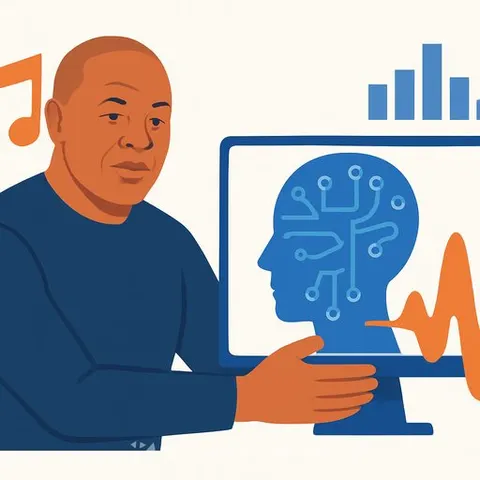
Dr. Dre has embraced AI in his music production work, telling the New York Times that he sees the technology as a creative tool rather than a threat. The producer, who shaped the sound of hip-hop for decades, compared current resistance to AI with the backlash that once met drum machines and synthesisers.
"I had a discussion with a few people a few days ago," Dre said. "They were against AI and I'm like, 'OK, you sound like the person that would have been against the drum machine when it came out'. Or synthesisers, right? It's a new tool for creativity. Some people are afraid of learning new things."
His comments land while the music industry remains split over how generative AI should fit into the recording process. Dre said he has already used the technology in his own work, treating it "as a tool to see what it would do with what I just did."
Two camps emerge in the AI debate
Dre's position puts him at odds with artists who see generative systems as a way to bypass the creative process entirely. Thomas Bangalter, formerly of Daft Punk, has described AI music creation that way. Other prominent musicians have pushed back against the growing influence of the systems.
Jimmy Iovine, Dre's longtime business partner, was similarly bullish in the same interview. He argued that talented artists could use AI to make stronger records rather than handing creativity over to a machine.
"I think the only people that see it as a threat are the people who have trouble creating," Dre said.
For creatives working across music and other disciplines, the debate raises practical questions about where the line sits between assistance and replacement. Dre's framing - AI extends what an artist can already do, it doesn't replace the artist - offers a working definition that many producers are likely to test in the coming months.
Platforms draw their own lines
While Dre and Iovine lean into the technology, platforms are moving in a more cautious direction. Beatport recently moved to ban fully or predominantly AI-generated music. Spotify has announced new labelling for AI-generated artists and content.
A SubmitHub study claimed AI involvement could be detected in 38.5 per cent of music released during July 2026, although detection technology remains contentious and some artists flagged by such systems have disputed the results.
Coming from one of hip-hop's most influential producers, Dre's endorsement adds weight to the argument that AI belongs in the studio. It also ensures the debate will continue - and that artists will keep having to decide where they stand.
Why this matters for creatives
For artists, songwriters, and producers, the practical takeaway is straightforward: AI tools are already part of the production workflow at the highest level of the industry. Dre's approach - using AI to react to and refine his own material - treats the technology as a collaborator with limits, not a replacement for taste or skill. That distinction matters for AI for Creatives deciding how to integrate these tools into their own practice. The same logic applies to AI for Vocal Artists & Songwriters - the artists who learn to direct the tool, rather than defer to it, are the ones who keep creative control.