
AI news ·
DreamX uses video diffusion model to learn universal latent actions across embodiments
KAIST researchers built DreamX, a method that compresses video frames by a factor of 300 to teach robots skills from human and robot videos. The system achieves top results on the LARY-Bench benchmark and enables zero-shot skill transfer between different robot bodies without retraining.
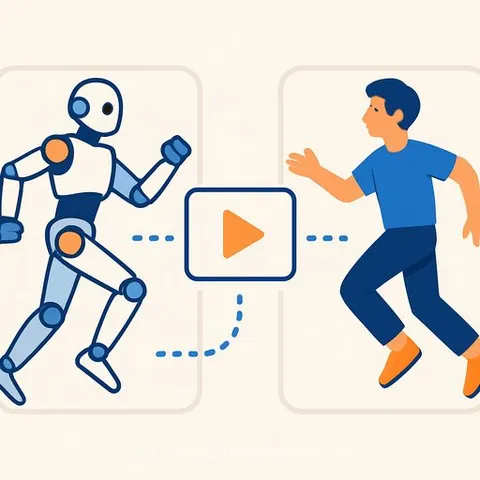
KAIST AI researchers have built a method that teaches robots new skills by watching videos of humans and other robots. DreamX extracts a compact, universal action language from a pretrained video diffusion model, compressing each video frame by a factor of 300 and discarding visual details like lighting or body shape. The system achieves top results on the LARY-Bench benchmark for latent action models and enables zero-shot skill transfer between different embodiments.
How DreamX strips actions from appearance
Existing latent action models often confuse the action itself with how it looks. A robot arm picking up a cup and a human hand doing the same thing share the underlying motion, but most systems treat them as different because the pixels differ. DreamX solves this by tapping into the internal representations of a pretrained video diffusion model. These models already understand motion and change across frames. The team extracts features from the model's spatiotemporal layers and compresses them into just four tokens per frame-down from 1,200 tokens in the original representation.
"Our approach extracts compact latent actions from the video model's rich spatiotemporal features, compressing each latent video frame by 300 times," the authors write. By leaning on the video model's generative prior, the system captures dynamics relevant to the action while ignoring visual appearance. The result is a shared latent space that works across human and robot embodiments, different environments, and varied action parameterizations.
Cross-embodiment transfer without retraining
The latent space functions as a common interface. Actions encoded from a human demonstration remain usable when decoded for a robot with a different body. The system supports any-to-any video transfer: a latent action extracted from one setting can be applied in another without additional training. This zero-shot capability sidesteps the usual bottleneck of collecting robot-specific demonstration data.
DreamX also compresses the action space for policy learning. Video-diffusion-based policies typically require heavy computation because they work with high-dimensional pixel data. By operating in the compact latent space, DreamX reduces that computational cost. The learned policies run faster while maintaining performance, a practical advantage for real-world deployment where inference speed matters.
Performance and practical implications
On LARY-Bench, a benchmark designed to test latent action models, DreamX outperforms existing approaches. The benchmark evaluates how well learned action representations capture consistent dynamics across different executions of the same task. DreamX's appearance-invariant design gives it an edge in scenarios where visual conditions change but the core action remains identical.
The implications stretch beyond robotics research. A universal action representation could simplify how creative tools understand motion, how event production systems coordinate automated cameras, or how product designers prototype interactive behaviors. Understanding the mechanics of generative video models is becoming relevant across disciplines-those interested in the underlying technology can explore AI Video Creation Courses or broader Generative AI Courses that cover the foundations of these models.
Why this matters for creatives, event producers, and product developers
For teams working in hospitality, events, or marketing, DreamX points toward tools that could recognize and replicate physical actions from video without manual programming. An event producer could capture a specific camera movement once and apply it across different venue layouts. Product developers exploring interactive displays could prototype gestures that transfer between different hardware setups. The core insight-that a pretrained video model already contains a disentangled understanding of action versus appearance-suggests future creative tools will become far more flexible in how they interpret and reuse motion data. The compute savings also matter: running complex video-based AI on standard hardware becomes more feasible when the action representation is 300 times smaller than the raw video model output.