
AI news ·
Eco Wave Power explores wave-powered data centers and AI energy tools with Florida Atlantic University and University of Michigan
Eco Wave Power is working with Florida Atlantic University and the University of Michigan on wave-powered coastal data centers and an AI platform to optimize wave energy output. The projects are pending funding approval.
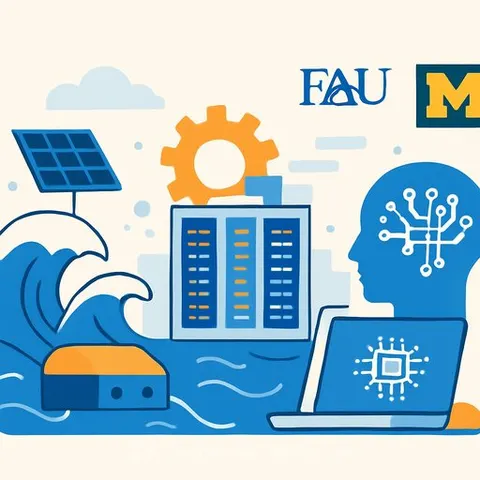
Wave Energy Company Advances AI Data Center Pilot With Universities
Eco Wave Power is developing AI-powered systems to optimize wave energy generation and exploring coastal data centers powered by ocean waves, the company announced June 8. The onshore wave energy firm is advancing discussions with Florida Atlantic University and the University of Michigan on two projects designed to connect renewable energy infrastructure with data center operations.
WaveGPT Platform Development
The first initiative focuses on WaveGPT, Eco Wave Power's AI-driven operational platform. The system converts real-time data from wave energy installations into performance insights using predictive analytics, anomaly detection, and digital twin technology.
Eco Wave Power submitted a research application to FAU focused on data-driven energy mapping and operational intelligence for its wave technology. The project aims to improve system performance and support future commercial deployments using advanced analytics methods.
Wave-Powered Data Centers
The second track targets a collaborative grant proposal for developing wave-powered, AI-optimized coastal data centers. The concept integrates wave energy generation, cooling systems, digital twins, energy storage, and intelligent workload management into a single platform.
The proposal addresses a specific problem: data centers supporting AI infrastructure require substantial electricity, intelligent energy management, and effective cooling. Locating facilities on coasts and connecting them directly to renewable generation and seawater cooling could reduce operational costs and carbon footprint.
The proposed platform would use AI-driven digital twins to forecast wave conditions, computing workloads, cooling needs, storage availability, and grid conditions in real time. This enables optimization across energy, water, and compute systems simultaneously.
Academic and Industry Recognition
NVIDIA featured Eco Wave Power's technology during CEO Jensen Huang's keynote presentations at GTC events in San Jose and Taipei, demonstrating the company's work on digital twins and real-world infrastructure applications.
Participants in the university discussions included researchers from FAU's Florida Power & Light Center for Intelligent Energy Technologies and the Southeast National Marine Renewable Energy Center, plus faculty from the University of Michigan.
"AI is expected to become one of the largest drivers of electricity demand in the coming decade," said Inna Braverman, Eco Wave Power's founder and CEO. "Wave energy can support the next generation of coastal digital infrastructure by combining energy generation, AI optimization, cooling technologies, and digital twins."
What This Means for Development Teams
For IT professionals and developers, these initiatives signal growing demand for engineers who understand both energy systems and AI infrastructure. Generative AI and LLM courses increasingly cover infrastructure optimization and predictive modeling-skills these projects require.
The coastal data center concept also reflects broader industry trends toward edge computing and distributed infrastructure. Understanding how AI systems can optimize physical infrastructure-energy, cooling, workload distribution-is becoming a practical skill rather than theoretical knowledge.
AI data analysis courses covering predictive analytics and real-time data processing align directly with the operational intelligence work described in WaveGPT development.
Next Steps
The discussions and grant applications remain subject to review and funding approvals. No timelines for implementation have been announced. Eco Wave Power operates the first grid-connected wave energy station in Israel and launched a pilot facility at the Port of Los Angeles in partnership with Shell Marine Renewable Energy.