
AI news ·
Elvis Presley rights holders and Eminem publisher file separate copyright lawsuits against AI music generator Suno
Elvis Presley's rights holders and Eminem's publisher sued AI music generator Suno for mass copyright infringement and unauthorized voice cloning. The Presley suit invokes Tennessee's ELVIS Act, while Suno's last funding round valued the company at $5.4 billion.
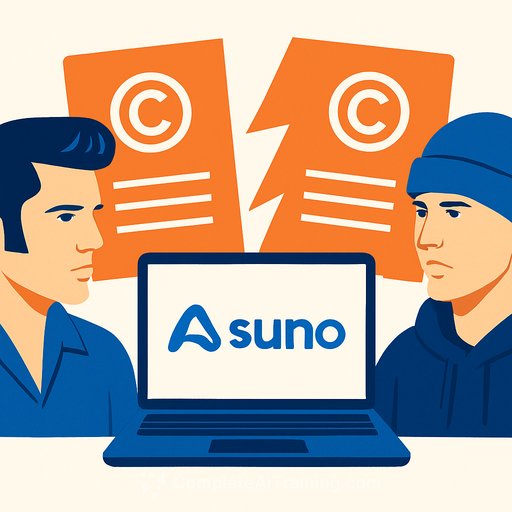
The owner of Elvis Presley's music rights and the publisher behind Eminem's catalog filed separate federal lawsuits against AI music generator Suno on Tuesday, accusing the company of mass copyright infringement and the unauthorized cloning of artists' voices. The cases, lodged in the Northern District of California, seek to halt what attorneys describe as a "conveyor belt of cold hard cash" built on unlicensed training data.
The Presley suit is brought by Authentic Brands Group, Raleigh Music Publishing, and other rightsholders. It alleges Suno violated the 2024 Ensuring Likeness Voice and Image Security (ELVIS) Act, a Tennessee law designed to prevent AI companies from replicating singers' voices without consent. The complaint claims users can generate tracks that mirror Presley's "rich vocal timbre" simply by citing his name in prompts.
Eight Mile Style, the LLC that controls hundreds of Eminem recordings including "Lose Yourself" and "The Real Slim Shady," filed a parallel complaint. It argues Suno's platform produces songs and lyrics that replicate the rapper's protected work. Eminem is not individually named as a plaintiff, and his representative did not respond to a request for comment.
Attorneys take aim at AI's creative cost
Richard Busch, Mark Block, David Niemierzycki, and Andrew Davis represent both the Presley group and Eight Mile Style. Their filings include generated audio examples that allegedly mimic Presley's voice or reproduce Eminem's lyrical style. The legal team framed the technology as an existential threat to human artistry.
"The next Elvis won't pick up a guitar," the attorneys wrote. "Suno's ravenous race to the bottom aims to make human creativity obsolete, coldly replicating without a license in seconds what takes years to learn, struggle with, maintain, and endlessly attempt to make better and perfect, begging the question from future generations who would attempt to start what is already an arduous, uncertain, and not always lucrative creative pursuit: 'What's the point?'"
Guardrails and workarounds
A Suno spokesperson said the company exists "to help people create new, original music, not to trade on anyone's name or likeness." The company prohibits prompts that name specific artists and uses third-party providers to screen uploaded audio and lyrics for misuse. "We are always working to strengthen our guardrails," the spokesperson added.
Earlier lawsuits, including one brought by Americana singer Jason Isbell, argue those guardrails are porous. Plaintiffs in the Isbell case claim users bypass restrictions by prompting for an artist's "tone and phrasing" using real names instead of stage names, or by inserting spaces between letters. Suno has denied those allegations and argued in court there is "nothing unlawful" about requesting a song in the vein of an artist.
A widening legal front
Both cases extend a pattern of litigation from the same parties. Authentic Brands Group joined other Presley publishers last month in suing Anthropic, claiming its Claude chatbot was trained on 274 Presley songs without permission. That suit demands $48.6 million in damages. Anthropic has denied the allegations.
Eight Mile Style sued Meta in June for roughly $110 million, alleging the company stored 243 of Eminem's recordings across Facebook, WhatsApp, and Instagram libraries without authorization. A federal judge in Michigan recently allowed that case to proceed to discovery. Meta's attorneys previously called the suit "fanciful."
Suno faces additional litigation from Round Hill Music, Universal Music Group, and Sony Music Entertainment. Warner Music Group settled its case with Suno last year. Deals with Warner, BMG, and Believe helped Suno launch its label-backed "v6" model in September - a move that prompted a fresh lawsuit from UMG and Sony, who called it "the fruit of the same poisoned tree." The legal pressure has not dented Suno's valuation: it raised $400 million in June at a $5.4 billion valuation.
Why this matters for creatives and rights professionals
These lawsuits test whether existing right-of-publicity laws and newer statutes like the ELVIS Act can constrain generative AI companies that train on copyrighted catalogs. For musicians, publishers, and the lawyers who represent them, the cases will clarify what constitutes voice cloning versus stylistic influence - a distinction with direct financial consequences. Marketing and PR teams working with artist estates should watch how courts handle the "tone and phrasing" workaround claims, as those rulings could reshape how brands commission AI-generated audio. Professionals navigating this intersection can build relevant expertise through AI Regulatory Compliance Courses and AI Intellectual Property Courses that cover the evolving legal frameworks around generative technology.