
AI news ·
ET Workplace 2035 summit examines what happens when AI becomes an active participant in enterprise decisions
Over 500 enterprise leaders gathered at ET Workplace 2035 to address AI's shift from pilot to enterprise-wide deployment. Panels stressed that organizations must now rebuild career ladders and workforce models as AI becomes an active participant in decision-making and work execution.
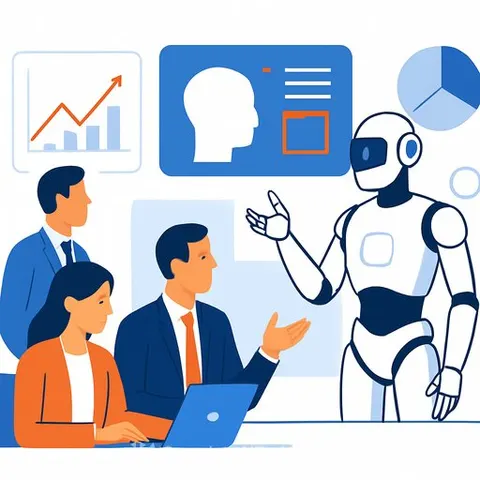
The Economic Times Business Verticals hosted ET Workplace 2035, a summit drawing over 500 enterprise attendees to examine the convergence of people, technology and AI. The event moved beyond treating the future of work as a technology story alone, bringing together CEOs, CIOs, CHROs, CFOs and transformation leaders to address how AI is becoming an active participant in decision-making, work execution and value creation.
The summit, presented by Oracle, co-presented by Accenture and Cornerstone OnDemand, and powered by Atlassian, was built on the premise that the challenge for leaders is no longer preparing for a single technological disruption. It is building institutions capable of continuously reinventing themselves as technology, talent and business models evolve.
Scaling AI beyond the pilot phase
The AI-Native Enterprise Track tackled the gap between successful AI experiments and enterprise-wide deployment. A mega panel on scaling AI brought together leaders from ICICI Bank, Ather Energy, ABB Energy Industries and Accenture LearnVantage. The discussion focused on what comes after a promising pilot proves its value: governance, data readiness, security, workforce adoption and a clear connection between AI deployment and business outcomes.
Another panel examined the data dilemma that constrains enterprise AI. Executives from Tata Projects, PI Industries, SBI Life Insurance and DBS Tech India explored how to break down data silos and build the architecture required for AI systems that can reason within an organisational context rather than merely retrieve information. A separate fireside conversation with a senior operations leader from Bajaj General Insurance examined the practical realities of implementing end-to-end automation and designing autonomous workflows.
Redrawing the lines between technology, finance and business
As AI embeds deeper into enterprise operations, traditional functional boundaries are being challenged. The AI Operating Model panel brought together the CTO of HDFC Life, the CFO of HDB Financial Services and a regional director from Oracle to discuss how CIOs and CFOs can build AI-powered operating models that improve agility while connecting technology investment to business performance.
The CEO Dialogue featuring the MD and CEO of IndiaFirst Life Insurance returned the conversation to the central strategic question: what does an organisation need to become if intelligence is embedded across its operating model? A session on secure-by-design with the Global CITO of Allcargo Logistics reinforced that cybersecurity and governance must be designed into AI architecture from the outset, not treated as downstream considerations.
The agentic enterprise and the structure of work
The AI-Powered Workforce Track examined implications for the structure of work itself. A mega panel on the agentic enterprise with CHROs from Persistent Systems, Blue Dart Express and PhonePe, alongside a director from Oracle India, explored how organisations can combine human talent, digital labour and intelligent agents to create new models of productivity. This represents a departure from the traditional automation debate. Organisations are beginning to consider which parts of a job should be performed by humans, which by machines, and how the two can work together.
A session on touchless hiring with the founder of RippleHire examined how intelligent systems could reshape recruitment workflows while retaining human intervention where judgment matters. The workforce track also addressed a less discussed consequence of AI adoption: what happens to organisational structures when technology takes over coordination, analysis and routine management work.
Career progression and employee value in an AI-augmented organisation
The panel on workforce readiness brought together group CHROs from Mahindra & Mahindra, Larsen & Toubro and Hindalco Industries. The conversation examined how leadership development, succession planning and career progression may need to be redesigned as organisations move toward flatter, AI-augmented structures. If traditional middle-management responsibilities are disrupted, organisations will need new ways to build leaders and transfer institutional knowledge.
A discussion on employee value with the chairperson of the Pension Fund Regulatory and Development Authority expanded the definition beyond compensation to include financial wellbeing and long-term security. A session on the reality of AI in HR, drawing on a study across over 500 enterprises in India, examined the gap between the promise of AI in human resources and actual adoption. For HR leaders looking to build these capabilities, AI for Human Resources is becoming a core competency rather than a niche interest.
The talent transformation blueprint session with the EVP and CHRO of Infosys explored the organisational changes required to embed AI into how people work. An augmented workforce panel featuring CHROs from Myntra, PhonePe and Titan Company discussed building workforces designed around capabilities rather than static job descriptions. Senior HR executives seeking structured development in this area can explore an AI Learning Path for CHROs designed specifically for this transformation mandate.
Why this matters for HR leaders
The summit surfaced a consistent message: the future of work is being designed through decisions organisations are making today, not predicted through distant scenarios. For HR leaders, the immediate implication is that traditional career ladders, leadership development pipelines and workforce planning models may need fundamental rebuilding. The shift toward agentic enterprises - where human talent, digital labour and intelligent agents operate together - means HR must move from managing static job descriptions to designing dynamic capability systems. The organisations that succeed will not necessarily be those that adopt AI fastest, but those that learn to align intelligence, people and purpose at enterprise scale.