
AI news ·
Eve Legal asks court to dismiss AI.Law patent suit
Eve Legal asked a San Francisco federal judge to dismiss AI.Law's patent suit, arguing the litigation-document patent covers only an abstract idea performed on a computer.
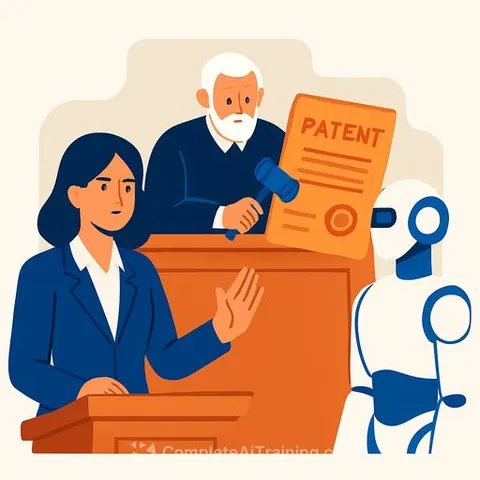
Eve Legal, a California legal technology company, has asked a San Francisco federal judge to dismiss a patent infringement lawsuit filed by Ohio-based rival AI.Law. The motion argues that the patent at issue covers little more than an abstract idea and fails to meet the legal standards for patent eligibility.
The dispute centers on technology used to automate portions of litigation document preparation. Eve Legal contends that AI.Law's patent describes a routine process - collecting data, generating a document, and filing it - performed on a computer. Under U.S. patent law, abstract ideas implemented with generic computing equipment do not qualify for patent protection.
The core of Eve Legal's argument
Eve Legal's challenge leans on the Supreme Court's Alice framework, which courts use to determine whether software and business-method patents claim eligible subject matter. The company argues that every step in AI.Law's patent could be performed by a human using pen and paper, with the computer adding nothing inventive.
AI.Law filed the suit earlier this year, alleging that Eve Legal's document automation tools infringe its intellectual property. The patent describes a system for generating litigation documents by pulling information from a database and applying rules to format the output.
What the patent actually covers
The patent's claims describe receiving case information, selecting a document template, populating fields, and transmitting the completed document. Eve Legal says this is a textbook example of an abstract process - one that courts have repeatedly found ineligible for patent protection when performed on generic hardware.
No hearing date has been set for the dismissal motion. If the judge grants it, AI.Law's infringement claims would be resolved without a trial. If denied, the case proceeds to discovery and potentially a jury.
Why this matters for legal professionals
Patent eligibility challenges under Alice have become a standard early defense in legal tech litigation. For attorneys evaluating or purchasing AI-driven document tools, a pending eligibility fight signals uncertainty about the vendor's IP position and could affect licensing terms, merger activity, or product roadmaps. Legal teams should ask vendors directly about outstanding patent disputes and whether their technology relies on proprietary methods or widely used automation patterns.