
AI news ·
Explainable header-centric framework maps 120,000 columns to data quality issues and semantic types
A new framework assigns semantic types to 120,000 spreadsheet headers without touching cell data, using token-level traceability to flag data quality issues. It then computes a HeadersIQ score, letting teams audit column meaning and dataset health before any data leaves secure storage.
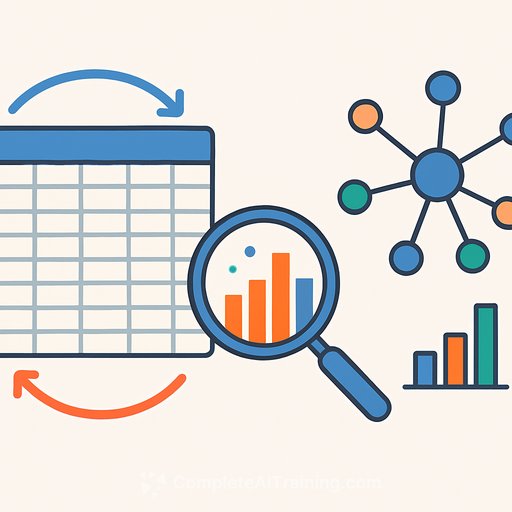
A new framework tackles a persistent problem in enterprise AI: making sense of messy spreadsheet headers without ever looking at the data inside. Researchers have built an explainable system that assigns semantic types to column headers alone - and then uses those types to flag data quality issues across entire datasets. The work was evaluated on roughly 120,000 header columns drawn from benchmarks including UCI, Kaggle, VizNet/Sato, and the SemTab 2024 Metadata-to-KG track.
This matters because organizations sit on mountains of spreadsheets and CSVs where cell values are missing, noisy, or locked behind privacy rules. Before any data can feed a knowledge graph or analytics pipeline, someone needs to figure out what each column actually means. The new framework does this with full traceability - every decision ties back to specific words in the original header.
How header-only typing works
The system maps column headers to 39 interpretable "FinalFormat" types using curated lexical resources. Think of types like PersonName, Date, or GeographicLocation. What sets this apart is token-level traceability through something called SourceKeywords. If a header reads "customer_birth_date," the system records exactly which tokens drove the classification. There is no black box guessing.
Each assigned type then activates a set of validation rules drawn from a taxonomy of Data Quality Issues. These rules catch problems like missing data, duplicate entries, domain violations, wrong data types, and temporal mismatches. The detections roll up into a single lightweight metric called HeadersIQ, which gives a data source-level quality score without requiring access to cell contents.
Benchmark results and diagnostic findings
The framework was tested across multiple heterogeneous benchmarks. On the SemTab 2024 Metadata-to-KG track, the official strict evaluation showed modest results. But the researchers conducted a blinded diagnostic audit that revealed a more nuanced picture: many mismatches stemmed from benchmark granularity choices, aliasing effects, and ontology-selection decisions rather than implausible predictions from the header-centric approach.
"Many mismatches reflect benchmark granularity, aliasing, and ontology-selection effects rather than wholly implausible header-centric predictions," the paper reports. This diagnostic evidence on disagreement patterns matters because it highlights how benchmark design can obscure real-world performance. A system that predicts "City" when the gold standard expects "Municipality" is not necessarily wrong - it is operating at a different semantic resolution.
The framework also includes a parallel KG-mapping pathway that supports alignment to DBpedia and other knowledge graph targets. This dual capability - semantic annotation plus quality monitoring - makes the system practical for teams preparing tabular data for downstream integration.
Why this matters for data professionals
For analysts, researchers, and product teams working with inherited spreadsheets, the promise is immediate. You can get a quality assessment and semantic map of your data before committing to expensive cleaning or integration work. The explainability component means you can audit the system's reasoning - a requirement in regulated industries like finance and healthcare. And because the framework operates on headers alone, it works on data that cannot be shared or moved due to compliance constraints.
The approach also offers a reusable diagnostic method for evaluating benchmarks themselves. Teams working on AI Data Analysis Courses or building internal data quality pipelines can apply similar auditing techniques to understand where their automated tools disagree with human annotators - and whether those disagreements signal real errors or just definitional gaps. For scientists and researchers handling heterogeneous datasets, the framework provides a way to assess metadata quality before analysis begins, an approach that aligns with broader efforts in AI for Scientists Courses to bring rigor to data preparation workflows.