
AI news ·
Federal courts hold all signing attorneys liable for unverified AI citations
Federal courts sanction every lawyer who signs briefs with AI-hallucinated citations. One ruling penalized five attorneys, including a $5,000 fine for the drafter.
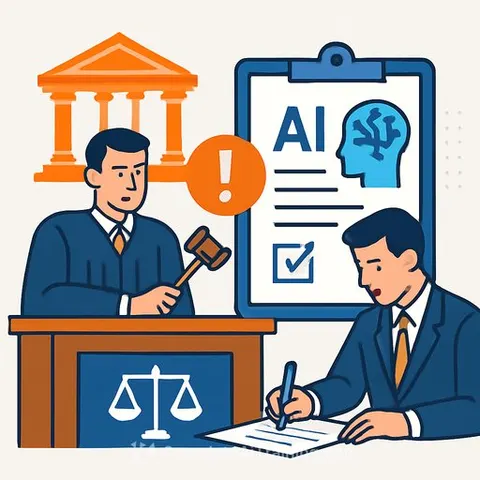
Federal courts are sending a consistent message on generative AI in litigation: use it, but verify every citation. Recent IP rulings show that when AI-hallucinated case law makes its way into a filing, sanctions can hit not just the attorney who used the tool, but every lawyer whose name appears on the brief.
Three decisions from 2024 and 2025 draw a direct line from Rule 11's duty of reasonable inquiry to the practical steps attorneys must take when AI tools contribute to legal drafting. The common thread is that signing a filing means certifying that the cited authorities exist and support the arguments made-and that responsibility is nondelegable.
The cases: hallucinations, sanctions, and shared liability
In Hernandez v. Lopez, a trademark dispute, the court set the baseline. After finding three authorities that "do not appear to exist" and were "likely hallucinated," the judge issued an order to show cause why sanctions shouldn't be imposed. The court's instruction was direct: "While the Court does not prohibit counsel from using generative AI tools, counsel must comply with Rule 11(b), including confirmation that cases cited within a brief exist."
Lexos Media IP, LLC v. Overstock.com, Inc. sharpened the point. A patent infringement filing contained fabricated quotations, non-existent citations, and materially misleading legal descriptions generated through ChatGPT. Only one attorney had used the tool and inserted the errors. Yet the court held all five attorneys whose names appeared in the signature block violated Rule 11(b)(2). Each had a nondelegable duty to conduct a reasonable inquiry before signing. The attorney who used ChatGPT without telling anyone-his firm, co-counsel, or the client-received a $5,000 fine, lost pro hac vice status, and must self-report to disciplinary authorities. Two senior attorneys and local counsel received smaller fines, and the firm's managing member was ordered to implement and certify accuracy procedures for future filings. The court stressed that local counsel adds credibility and must independently confirm a filing's accuracy.
A third case, Meril and Keith Dillard v. CBS Studios, Inc., shows that AI errors can sink a case entirely. The pro se plaintiff's copyright complaint included mischaracterizations of prior orders, apparently AI-generated images, and an opposition brief citing non-existent opinions. The court dismissed with prejudice, finding that amendment would only produce "additional unsupported allegations" rather than cure the defects. Pro se parties, the court noted, are also bound by Rule 11.
Liability travels with every signature
The Lexos Media decision makes clear that a blanket prohibition on AI use by one practice group or firm won't limit exposure. If one attorney inserts unverified AI content, the entire team on the signature block is at risk. Supervising attorneys, local counsel, and co-counsel cannot assume someone else has confirmed the citations. The duty to verify attaches to each signer individually.
This is particularly acute in IP litigation, where briefs often combine specialized precedent, technical records, and contributions from multiple firms. The dense, doctrine-specific material is exactly the kind where AI hallucinations are easy to introduce and hard to spot. A plausible-sounding but fabricated quote can damage credibility, weaken a party's position, and affect a court's willingness to permit amendment.
Practical governance, not AI bans
The decisions do not tell lawyers to stop using AI. They demand a verification process that catches errors before filing. Possible governance standards include requiring internal disclosure of AI use to supervisors, confirming that each cited authority supports the stated proposition, assigning clear review responsibilities, and ensuring substantive review by supervising and local counsel. The focus should be on a reliable process that ensures accuracy and accountability. Understanding these obligations is critical for lawyers using AI for Legal tasks, where the line between efficiency and ethical exposure is drawn by the verification step.
Why this matters for legal professionals
An AI-assisted brief that contains hallucinated citations is not a technology problem-it's a supervision and verification failure. Rule 11 liability extends to every attorney who signs, and sanctions can include fines, loss of pro hac vice status, and mandatory reporting to disciplinary authorities. The practical takeaway is not to avoid AI, but to build a verification workflow that treats every AI-generated citation as unverified until a human checks it against the primary source. In IP litigation, where technical accuracy and precedent are everything, that workflow is now a professional necessity.