
AI news ·
FIFA deploys AI across officiating, player analytics and operations for the 2026 World Cup
FIFA will use machine learning to manage 104 matches at the 2026 World Cup. The upgraded offside technology reduces the detection threshold to 10 centimeters.
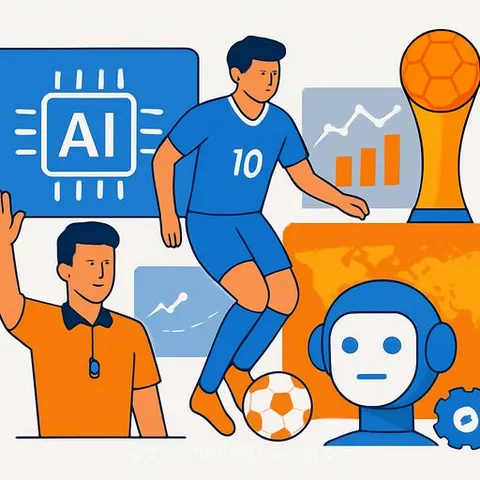
The 2026 FIFA World Cup will deploy distributed computing and near-real-time machine learning systems to manage 104 matches, 48 teams, and 16 host cities across North America. This tournament functions as a live test of low-latency officiating, biometric tracking, and multi-vendor enterprise orchestration under extreme availability constraints.
Officiating and edge computing
FIFA's upgraded semi-automated offside technology (SAOT) reduces the detection threshold from 50 centimeters to 10 centimeters, catching tighter calls that previously required human review. Clear alerts now route directly to the on-field referee's earpiece in near-real time, bypassing the Video Assistant Referee relay step that historically caused extended stoppages. The system does not rule autonomously on subjective cases, leaving interference and ambiguous body position judgments to human officials.
Data streams and player tracking
This officiating system draws on three converging data streams. The official Adidas Trionda match ball contains a 500Hz inertial measurement unit that timestamps the precise millisecond of every kick. Sixteen high-resolution optical tracking cameras per stadium reconstruct each player's 3D body-point positions using personal digital avatars generated from one-second 3D scans. These player-specific geometries replace generic body models and appear in broadcast replays to explain decisions to viewers.
Analytics and operational logistics
FIFA and Lenovo are providing Football AI Pro, a generative analytics assistant, free to all 48 national teams. This tool ingests hundreds of millions of data points to produce insights as text, video, charts, and 3D simulations, acting as an equity measure for squads without large data science budgets. Meanwhile, Salesforce will coordinate workforce management and host-city logistics across all 16 cities using its Agentforce 360 portfolio and Slack, demonstrating how AI for Operations handles scale in live, multi-vendor environments.
Team preparation and security
National squads are already integrating continuous telemetry into their daily routines. Brazil's head of sports science Guilherme Passos said, "On a daily basis, when we are not with the players, we communicate with the clubs and they send us the players information from the tracking system." Concurrently, FIFA has extended its AI-based social media protection service to filter abusive content against 30,000 keywords across major platforms within two seconds. US cybersecurity agencies have also flagged the expanded attack surface created by digital ticketing and temporary vendor systems across three countries.
Why this matters for operations professionals
Managing this tournament requires solving common engineering challenges under strict reputational constraints. Teams must synchronize clocks across camera and wearable systems, enforce deterministic latency budgets, and maintain model versioning during a live event. Professionals following the AI Learning Path for Operations Managers can study this tournament as a concrete blueprint for hybrid computing, combining edge processing for latency-sensitive decisions with central cloud aggregation for broader tactical analytics.