
AI news ·
Fink warns cash savings are a losing bet as AI widens wealth gap
BlackRock CEO Larry Fink says keeping money in bank accounts is "one of the worst financial decisions," citing that 40% of Americans have no capital market exposure as AI-driven wealth concentrates among investors.
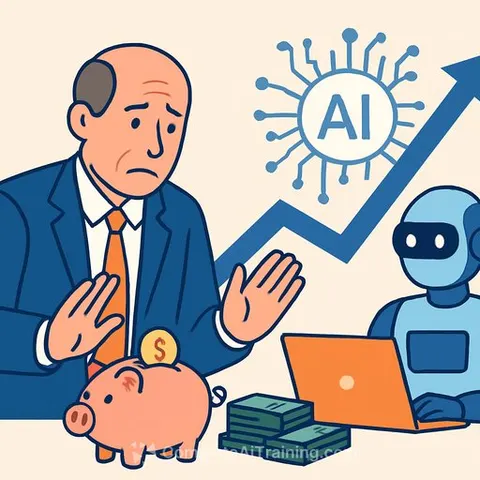
BlackRock CEO Larry Fink warned that keeping money in a bank account is "one of the worst financial decisions of a lifetime," arguing that ordinary Americans must own capital assets to share in AI-driven wealth creation as the technology boom widens the gap between asset owners and wage earners.
Speaking at the Milken Institute Global Conference in May 2026, Fink made the assertion as he outlined his vision for how Americans should position themselves amid artificial intelligence's economic transformation. The BlackRock chief's core argument centers on a fundamental economic shift: in an AI world, capital appreciation will outpace wage growth, leaving those relying solely on salaries increasingly behind.
"We are not going to be able to broaden economic success only by wages, because wages in this AI world are not going to grow as fast as the potential of the AI growth - and capital that is going to be invested in these investments will outperform," Fink said, according to reporting by Yahoo Finance. His proposed solution is direct: ordinary people must move beyond saving and into investing alongside their economy's growth.
The gap between savers and investors
Fink's warning builds on concerns he raised in his 2026 annual chairman's letter to investors, where he flagged that artificial intelligence risks concentrating wealth among those who already own assets. According to figures cited by Fink, roughly 40 percent of Americans have no exposure to capital markets whatsoever, leaving them unable to capture gains from the AI boom.
The BlackRock chief has long championed long-term saving as the hedge against economic disruption. In his letter, he noted that over the past two decades, every dollar invested in the S&P 500 grew more than eightfold, a performance vastly outpacing traditional savings accounts. High-yield savings accounts currently offer rates between 3 and 4.5 percent annually, while the stock market has historically returned around 10 percent per year on average, according to financial data providers.
AI's wealth concentration problem
Fink's position reflects a broader concern among financial leaders about inequality in the AI era. When artificial intelligence concentrates economic gains among technology companies and their investors, those without capital exposure risk being left behind, he has argued. His 2026 letter warned that the AI boom could create enormous economic value while simultaneously deepening the wealth gap unless broader market participation expands.
The warning carries particular weight given BlackRock's influence over global capital allocation. As the world's largest asset manager, Fink's views shape investment strategies for trillions of dollars. His message to Americans is blunt: capital appreciation is no longer a conservative asset class in an economy being reshaped by AI-driven productivity gains and wealth concentration.
Why this matters for finance professionals
For finance professionals, Fink's remarks signal a shift in how client conversations should be framed. The data he cites - 40 percent of Americans with no market exposure, savings rates below 4.5 percent versus historical equity returns near 10 percent - gives advisors a concrete basis for pushing clients toward investment products rather than cash positions. The broader implication is that AI for Finance professionals must understand how AI-driven capital appreciation changes portfolio construction and client education. For those advising executives and boards, the AI Learning Path for CFOs offers a framework for evaluating how AI investments reshape balance sheets and long-term value creation.
The practical takeaway: Fink is not predicting a market crash or urging panic. He is describing a structural shift where wage growth lags capital growth, and the investment strategies that worked for the last two decades may not capture the next wave of value creation. Finance professionals who can articulate this dynamic - and build portfolios that reflect it - will be better positioned to serve clients navigating the same question Fink posed: are you an owner of capital, or just a participant in the economy?