
AI news ·
Firms shift focus from SEO to generative engine optimisation as AI reshapes online reputation
Semrush projects generative engine optimisation will overtake traditional SEO by 2028. Businesses must proactively influence AI answers across third-party sources, which account for 90% of citations.
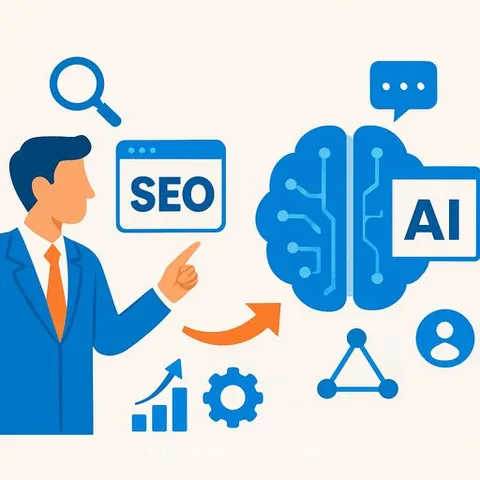
Businesses must be increasingly aware of their online reputations as consumers rely on artificial intelligence to answer search queries instead of traditional search engines, according to Jack Wheeler, Partner and GEO Expert at Pead. Projections from web analytics firm Semrush show generative engine optimisation (GEO) overtaking traditional SEO by 2028, narrowing the window that companies have to get up to speed with AI search.
"We are thinking not only about how AI could transform our business, but also how it influences how consumers, stakeholders and audiences receive information and form opinions on businesses," Wheeler said.
What is GEO and why it matters
GEO, also referred to as answer engine optimisation (AEO), or AI search, focuses on influencing how large language models represent businesses when responding to user prompts. Unlike SEO, which aims to improve rankings on Google's search results page, GEO centres on ensuring AI-generated answers accurately represent an organisation's reputation, expertise and credibility.
Wheeler explained every organisation with an online presence is already participating in the AI search ecosystem, whether they realise it or not. Those that are proactive are much better placed to influence the results, and therefore how the public perceives them. "Any business that's got an online footprint is represented by these AI tools. The difference is the businesses who are approaching it with purpose and influencing what's said about them versus those who are just relying on what's naturally out there," he said.
Reputation overtakes rankings
Unlike SEO, which rewards websites that successfully navigate Google's ranking algorithm, GEO depends heavily on how consistently a company's reputation is reflected across authoritative third-party sources. Research shows approximately 27 percent of AI citations originate from traditional media, while around 90 percent come from third-party sources overall. That ecosystem includes news organisations, universities, industry bodies, government agencies, and less easily verified content from YouTube and Reddit.
"It's about understanding the high-authority sources that can legitimately talk about you and your business," Wheeler said. "It's about having an online footprint where there's a range of third-party, high-authority sources backing up what you say about your business."
Communications strategies must evolve
The emergence of AI search is changing the communications ecosystem. PR professionals and journalists are no exception. While media coverage remains important, communications strategies must now encompass a much wider range of trusted information sources. GEO should not be viewed as a standalone service, but rather as an evolution of reputation management.
"We want every relevant person or organisation of influence talking about what's important about our brand and what strengthens our reputation," Wheeler said. The objective is to ensure AI systems encounter a consistent and credible image of an organisation wherever they gather information.
Media companies face a dilemma: allow AI systems to access their content, knowing they may receive less referral traffic, or restrict access and risk becoming less visible within AI-generated answers. Wheeler compared the situation to the rise of social media in the 2010s, where publishers distributed content through platforms that began taking significant shares of the advertising market. "The question is whether blocking AI will stop people using LLMs as their primary source of information. I don't think it will."
Why this matters for PR and communications professionals
The shift from SEO to GEO means PR teams can no longer rely solely on high rankings in search results. They need to ensure consistent, positive representation across a broad range of trusted sources - traditional media, academic papers, industry bodies, and government agencies. For professionals in this field, the time to start understanding AI for PR & Communications and adopting a learning path for media relations specialists is now, before AI search becomes the default way people find and evaluate businesses. The window for influence is narrow, and organisations that act with purpose will shape their own reputation rather than leaving it to the algorithm.