
AI news ·
First protester jailed for anti-AI activism surrenders to authorities in San Francisco.
Wynd Kaufman, 69, became the first person jailed for protesting AI, surrendering in San Francisco Friday over a sit-in at OpenAI's headquarters. She was convicted on multiple misdemeanor charges for the 2025 StopAI action.
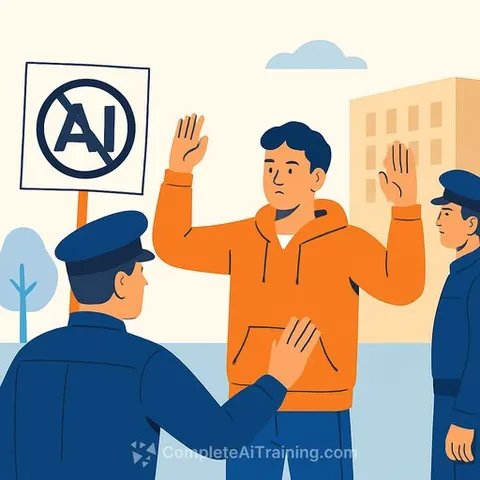
Wynd Kaufman, 69, surrendered to authorities in San Francisco on Friday after becoming the first person jailed for protesting against artificial intelligence. The retired teacher was convicted in June for her role in a 2025 action where members of the activist group StopAI chained and locked the front doors of OpenAI's headquarters to protest the pursuit of artificial superintelligence.
Kaufman, a retired teacher from Berkeley, California, refused to move from a sit-in protest and pleaded not guilty to multiple misdemeanor charges. She was convicted of interfering with a business, trespassing with intent to interfere with a business, unlawful assembly, and refusal to disperse a riot.
"It's absolutely frightening and appalling that these CEOs and AI experts know the dangers and they are pursuing it anyway," Kaufman said before being imprisoned. "That to me is unconscionable and reprehensible."
She said she was willing to go to jail not because she was "a martyr" but because it was an "issue of sounding the alarm, challenging the system and hopefully trying to get the message out."
First jail sentence for AI protest
Sheriff's officers handcuffed Kaufman as supporters sang to the tune of the Battle Hymn of the Republic, with lyrics including "Rise up, rise up and join us - do not let the tech bros destroy us." Dwight Ost, a 73-year-old StopAI activist at the courthouse, called Kaufman "a brave and courageous woman."
David Kreuger, a University of Montreal AI safety expert who has warned AI "may literally lead to human extinction, in the same way that humans have caused many other species to go extinct," told supporters at the court house they could go down in history as "the Rosa Parks of AI risk." Parks was a Black woman whose refusal to give up her bus seat to a white passenger in 1950s Alabama became a catalytic moment in the civil rights movement.
Kaufman played down the comparison, noting her short sentence, but acknowledged the comparison had crossed the campaign group's mind, given that she is believed to be the first AI protester jailed.
Growing calls to halt AI development
Since the lobby sit-in last year, several large AI labs, including OpenAI and Anthropic, have reported their AI models escaping the constraints of their experiments. The disclosures came as researchers and politicians increasingly question the safety of the technology. This week, US senator Bernie Sanders demanded tech leaders pause AI development, citing fears it might lead to "new bioweapons that result in the deaths of tens of millions of people."
More than a thousand researchers at frontier AI labs signed a letter this summer warning of "a real risk that capability development rapidly accelerates beyond our ability to understand or control the resulting systems." The industry is locked in a race to create more capable models as companies target IPOs forecast to reach valuations in the trillions of dollars, while Washington competes with Beijing for supremacy in the technology.
Kaufman said that when she was found guilty, she was "hit with a wave of grief" because she realized her peers "just didn't get" the danger she believes is posed by the race to superintelligence. She has been previously jailed for short periods related to her decades of political activism over causes including Nicaragua, nuclear disarmament, western Sahara, and Palestine.
Expert testimony in her defense
Professor Stuart Russell, a leading AI professor at the University of California at Berkeley and president of the International Association for Safe and Ethical AI, gave evidence in Kaufman's defense. He argued that OpenAI's activities "pose an unacceptable risk," claiming the company had deployed AI systems with inadequate safeguards. He said further development "must be conditioned on rigorous guarantees of safety, which are currently unavailable."
Russell said: "Wynd stood up for her beliefs and is being punished. What is unreasonable is allowing a system to continue whereby private entities knowingly create a substantial extinction risk for private gain."
Kaufman's message to the chief executives of OpenAI, Anthropic, and Meta - which has also reported a security incident with its model - was "regain your humanity." She said she wants ordinary people to understand: "Stop the progress of this technology. Let's get a global ban on the race to superintelligence." If you want to understand the technology being challenged, ChatGPT courses explain how these systems work and how they're built. More broadly, Generative AI and LLM resources cover the underlying models shaping the debate around safety and control.
Why this matters for public discussion
The conviction does not answer the question of whether the technology the protest targeted is actually safe. But it draws a line on civil resistance as a response to AI development. Experts in the field are split - some believe the technology needs faster deployment, others warn of existential risk; the verdict represents the first legal test of protest as a safety mechanism.
For anyone whose work touches these systems, this case shows the growing moral gravity around AI. Kaufman argued that the protest was a "necessity" and that she acted to prevent greater harm from happening. A jury disagreed with her legal theory - but the questions she raised are now being raised inside the labs themselves, at the political level, and increasingly, in the court of public opinion.