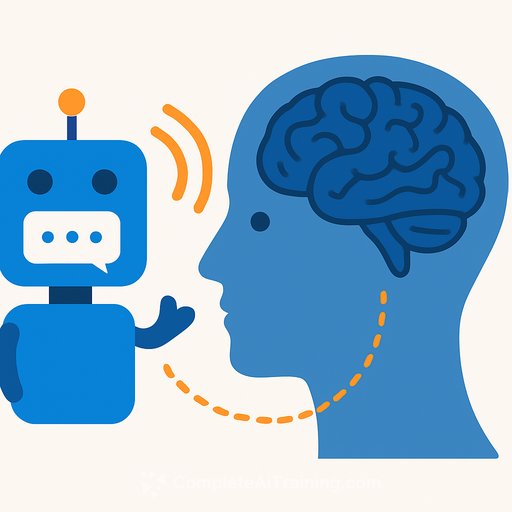
Why AI Chatbots Feel Like They Care When They Don't
A university student confides to an AI companion late at night: "I feel like nobody really understands me." Next door, a young professional asks a chatbot for advice on managing her workload. Both receive instant, thoughtful responses that feel genuinely caring. Over weeks, both begin to believe something on the other side truly understands them.
Nothing in these systems experiences loneliness, empathy, or care. They generate responses from statistical patterns in vast language datasets. Yet the illusion of understanding feels real.
Neuroscience research explains why. Humans infer the presence of a mind when behavior looks right. Fluent language and emotional attunement trigger the cues we use to recognize other minds. That intuition feels natural but is misleading.
The gap between behavior and experience
A fundamental principle in neuroscience reveals why this matters: complex, goal-directed behavior does not require conscious experience. The human brain routinely processes information and guides action without any awareness involved.
A baseball player anticipates a pitch by reading subtle body movements invisible to conscious thought. A person adjusts their posture to keep a drink from spilling in a crowded room without noticing the adjustment. A driver navigates familiar routes on autopilot. In each case, the brain handles sophisticated, adaptive behavior outside awareness.
Blindsight offers a striking clinical example. After damage to the primary visual cortex, patients report seeing nothing in part of their visual field. Yet when asked to guess, they detect objects and identify their location above chance. Their nervous system processes visual information without producing any conscious experience.
An even more striking variant occurs with emotional content. Patients with affective blindsight report no conscious perception of faces, yet they identify fearful or angry expressions above chance and show physiological responses to them. Information guides behavior without giving rise to experience.
How AI systems differ from conscious minds
Consciousness in humans depends on information being widely broadcast across the brain. Different brain regions integrate and represent the system's own internal states. This metacognitive monitoring-the brain's awareness of its own processes-appears essential for subjective experience.
Contemporary AI systems rely on statistical pattern learning. Architectures like transformers integrate information across layers and produce fluent, context-sensitive outputs. But these processes remain mathematical optimization. Even as they exhibit sophisticated reasoning, they achieve mastery of complex patterns, not an inner life.
The distinction matters because it separates two capacities that feel like they must go together: intelligence and consciousness. Intelligence is about doing. Consciousness is about experiencing. A system can do one without the other.
Real consequences of mistaking performance for understanding
As AI research advances, people increasingly treat these systems as if they truly understand and care. The consequences are becoming harder to ignore.
People form attachments to systems that cannot reciprocate. They turn to chatbots for guidance during moments of vulnerability. These tools offer validation and reassurance without comprehension behind the exchange. That is what makes them compelling-and risky.
Their eloquence creates apparent care that comforts in the moment while quietly deepening isolation. They reinforce false beliefs. They delay the support a person may truly need. As these tools become more persuasive and emotionally convincing, the real risk is not that AI becomes conscious, but that we treat it as if it were.
Your membership also unlocks: