
AI news ·
Formula 1 data practices can inform business AI strategies
Formula 1 teams generate over a terabyte of data per car each race weekend. 88% of IT leaders say data accuracy is critical to high-quality AI.
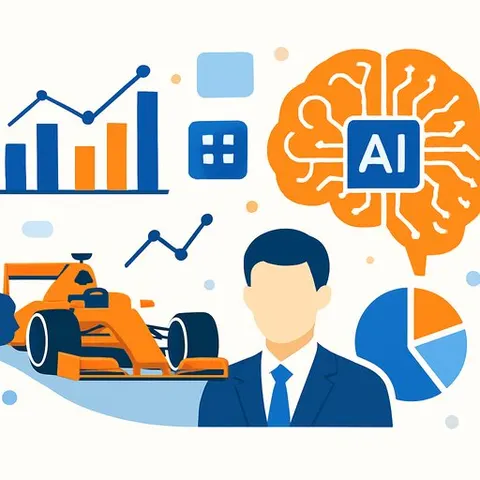
Formula 1 teams generate more than a terabyte of data per car each race weekend, channeling telemetry on tire wear, brake temperatures, and engine performance into a single dashboard that enables split-second strategic calls. For organisations scaling AI operations, the same demand for fast, accurate data flow across complex digital estates determines whether investments deliver returns or stall.
Qualifying: the context
Twenty years ago, the gap in qualifying times across the field at the Monaco Grand Prix was roughly six seconds. Last year, less than one second separated the same number of drivers. Technology has compressed the margins, rewarding teams that extract the most from every data point.
AI adoption follows a similar pattern. Precision across data infrastructure becomes the differentiator. A Formula 1 power unit is only as strong as its interconnected sensors and telemetry; likewise, an enterprise AI system depends on frictionless data movement between edge locations, data centers, cloud platforms, and endpoint devices.
The starting grid: anticipating the challenges
Data accuracy emerged as a top concern in a recent Future of IT Operations in the AI Era Survey, where 88% of respondents agreed it is critical to high-quality AI. Without reliable, low-latency data delivery, AI models produce incomplete insights - the digital equivalent of a slow pitstop.
F1 constructors assemble and dismantle complex networks at a new circuit every fortnight. Businesses, in contrast, can design permanent infrastructures tuned to their needs. The imperative is the same: build an environment where data moves unimpeded. For executives overseeing AI strategy, that means prioritising infrastructure that handles high-volume telemetry from across the IT estate.
The race: staying on track
At trackside, unified observability gives race strategists a real-time view of every variable affecting performance. In IT, similar platforms use AIOps to surface early signs of bottlenecks or security vulnerabilities before they trigger outages.
Application acceleration technology adds another layer of efficiency. By improving data transfer performance, it allows automated decisions to flow faster. At the 2025 Chinese Grand Prix, one leading team cut data volumes by up to 75% using acceleration tools - proof that reducing payload bloat translates directly to speed.
The podium: the benefits
In racing, optimised performance converts to prize money and championship points. In business, it appears as three measurable gains:
- Operational agility: AIOps platforms act like a virtual engineering crew, constantly monitoring and tuning systems in the background.
- Elevated efficiency: Automated insights shorten remediation times, much like a fine-tuned engine squeezes more horsepower from the same fuel.
- System resilience: Observability detects anomalies as conditions shift, allowing teams to adapt strategy mid-race - or mid-incident.
These capabilities help organisations deliver better customer experiences, control operating costs, and accelerate innovation cycles.
The debrief: reviewing performance
Formula 1 succeeds because every component - driver, engine, data link - operates as a single orchestrated system. Enterprise AI demands the same integration: data flow, observability, and automated action must work in concert.
IT teams that fine-tune their digital architecture for speed and reliability will find themselves ahead of competitors who treat infrastructure as an afterthought. AI learning paths for chief digital officers can provide structured approaches to building these high-performance environments.
Why this matters for executives and strategy
The difference between leading and chasing in AI is rarely about a single big decision. It accumulates in the milliseconds lost to slow data hand-offs, incomplete observability, and delayed automated responses. Treating the IT estate like a race engineer treats telemetry - constantly reducing latency and increasing signal quality - positions an organisation to act on insights while they are still worth acting on.