
AI news ·
Foxconn's Nurabot Cuts Nurse Workloads by Up to 30%
Nurabot, an AI nursing assistant from Foxconn, takes on meds, samples, and supply runs so nurses focus on care. Pilots cut workload 20-30%, with rollout eyed for 2026.
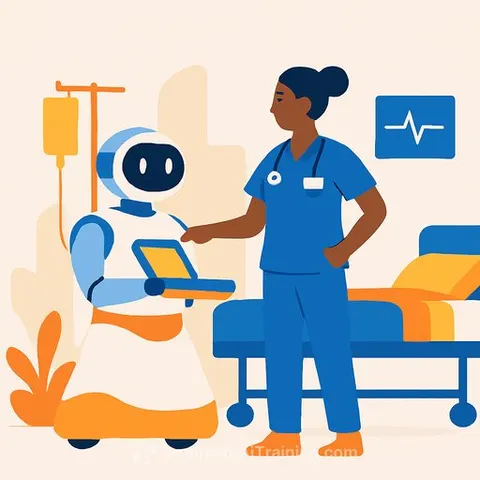
Nurabot: An AI-enabled nursing robot built to take the strain off hospital staff
By 2030, the world could be short 4.5 million nurses, according to the World Health Organization. Burnout is already high and turnover is expensive. Hospitals need practical ways to protect time for clinical judgment and patient care.
Enter Nurabot, an autonomous nursing assistant developed by Foxconn (Hon Hai Technology Group). It's built to take over repetitive and physically demanding errands so nurses can focus on assessment, decisions, and high-touch care.
What Nurabot actually does
Nurabot handles routine tasks like delivering medication, moving samples, fetching supplies, and guiding patients around a ward. Early pilots show a reduction in nursing workload of about 20-30%, based on walking distance and delivery accuracy metrics.
"This is not a replacement of nurses, but a way to accomplish the mission together," says Alice Lin, director of user design at Foxconn.
How it works (without adding burden)
Hardware: Foxconn adapted Kawasaki Heavy Industries' Nyokkey service robot. The unit rolls on wheels, uses two robotic arms to lift and hold items, and relies on multiple cameras and sensors to avoid obstacles. There's a secure compartment for meds and vials to keep handoffs traceable and safe.
Software: Foxconn's language model handles natural conversation. NVIDIA supplies core AI and robotics infrastructure, combining multiple platforms so the robot can plan routes, manage task queues, and respond to verbal and physical cues. The team trained and tested behaviors in a virtual hospital before real-world trials to speed development and reduce risk. According to NVIDIA's David Niewolny, the system adapts behavior to patient, context, and situation.
Where it's being tested
Nurabot is in pilot at Taichung Veterans General Hospital in Taiwan on a ward treating lung, face, and neck diseases (including lung cancer and asthma). During testing, access to hospital systems is limited while Foxconn stress-tests reliability, safety, and workflow fit.
Metrics tracked include walking-distance reduction for nurses, delivery accuracy, and qualitative feedback from staff and patients. Formal integration with the hospital information system is planned later this year, with a commercial debut targeted for early 2026. Pricing is not yet set.
Benefits and the open questions
Demographics are pulling the system tight: the population aged 60+ is growing fast, and by the mid-2030s people 80+ are projected to outnumber infants. See WHO's overview on ageing and health for context: WHO Ageing & Health.
Rick Kwan, nursing and public health professor and associate dean at Tung Wah College, expects AI-assisted robots to save significant manpower by taking over repetitive tasks. He also flags critical issues: patient preference for human interaction, crowded and narrow ward layouts that restrict robot movement, and the need to rethink hospital design if robots become part of core workflow.
Safety is non-negotiable. Beyond physical safety, hospitals will need clear policies for ethics, data protection, audit trails, and fail-safes. A recent review of nursing robots found perceived efficiency gains but limited experiential evidence, plus challenges like malfunctions, communication gaps, and ongoing training needs.
Context: hospitals are already testing the model
Robots are not new in care delivery-surgical systems have supported OR teams for decades. On wards, Changi General Hospital in Singapore uses more than 80 robots for tasks from admin to medicine delivery, and in the U.S., nearly 100 Moxi units move meds, samples, and supplies across hospitals.
Market signals
Health tech investment is surging as hospitals look for time and cost savings. The smart hospital segment was estimated at $72.24 billion in 2025, with Asia Pacific as the fastest-growing region.
What this means for your hospital
- Map the work: List top time sinks for nurses (samples, meds, supply runs, patient escort). Quantify walking distance and handoffs.
- Start controlled pilots: Limit system access, define fail-safes, and test during low-risk shifts. Track delivery accuracy, turnaround time, and nurse satisfaction.
- Plan the floor: Identify choke points and narrow corridors. Create parking, staging, and charging zones that don't block staff or patients.
- Integrate with intent: Connect to the HIS in phases with least-privilege access. Use clear task queues and standardized handoff protocols.
- Build human trust: Set expectations with patients and families. Keep nurses in the loop; make the robot a teammate, not a barrier.
- Operational resilience: Define downtime procedures, maintenance schedules, and escalation paths when tasks fail or routes are blocked.
- Governance: Establish ethics, data security, camera/sensor policies, audit logging, and periodic safety reviews with nursing leadership.
- Upskill the team: Offer short, role-based training for nurses, porters, and pharmacists. For broader AI literacy across roles, see curated options by job here.
What to watch next
In the current pilot, Nurabot is reducing nursing workload by roughly 20-30%. The next milestones: full ward integration later this year, autonomous task execution connected to the hospital information system, and a planned commercial release in early 2026.
Bottom line: robots like Nurabot won't fix staffing gaps alone, but they can remove the grind work that pulls nurses away from patients. Measure what matters, start small, and scale what proves reliable, safe, and genuinely helpful to staff and patients.