
AI news ·
From AI deepfake crackdowns to NOAA weather radio upgrades: Congress' busy week in tech legislation
Congress moves a slate of bills on quantum sims, AI talent, cloud labs, telecom, anti-impersonation, Lending.gov, NOAA radio, and HBCU AI. Why it matters-and what to do next.
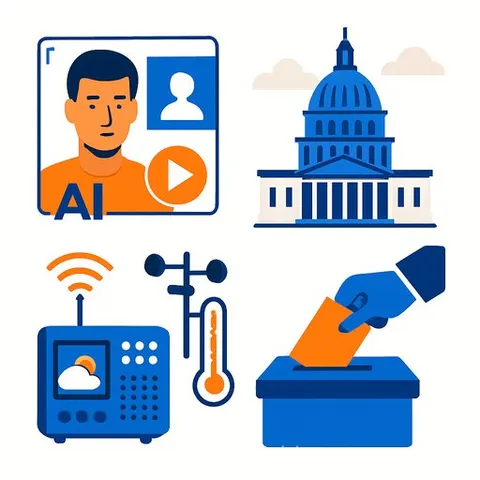
Tech bills of the week: quantum sims, AI workforce, cloud labs, telecom AI, anti-impersonation, Lending.gov, NOAA weather radio, HBCU AI research
New proposals in Congress this week touch core areas IT and engineering teams care about: compute, data, tooling and talent. Here's what each bill does, why it matters for builders and concrete next steps you can take.
Enhancing quantum computing research
A House bill moves to amend the National Quantum Initiative Act to explicitly back quantum modeling and simulation. Until fault-tolerant, cryptographically relevant machines exist, high-fidelity sims are how teams test algorithms, error mitigation and domain use cases like molecular chemistry (including nitrogen fixation for fertilizer).
- What to do: Track federal calls for quantum simulation benchmarks and datasets; plan for hybrid HPC+quantum workflows.
- Developer angle: Expect funding signals for quantum-inspired algorithms, circuit simulation frameworks and chemistry toolchains.
- Resource: See AI for Science & Research for practical workflows that bridge AI and lab research: AI for Science & Research
Expanding AI education and career development
The NSF AI Education Act would expand programs to build a domestic workforce in AI and quantum across K-12, community colleges, vocational schools and minority-serving institutions. It leans on CHIPS and Science Act authorities, sets up at least five Centers of AI Excellence and involves the Agriculture Department, with emphasis on AI in modern agriculture and advanced manufacturing.
- What to do: Partner early with community colleges and MSIs for apprenticeships; prepare faculty toolkits and project-based curricula.
- Developer angle: Build capstone-ready projects in ag-tech and manufacturing (vision, robotics, edge inference, MLOps on constrained hardware).
- Resource: Program design ideas and grant-aligned content: AI for Education
Modernizing and streamlining federal loan programs
Lending.gov is proposed as a single access point for 175+ federal loan programs, with goals to cut fraud and operating costs and speed up service. For technical teams, this suggests a consolidated identity, risk and data-sharing stack replacing scattered, legacy systems.
- What to do: Prepare for common data standards and APIs across lending products; design modular KYC/KYB, fraud analytics and case management.
- Developer angle: Build event-driven pipelines with explainable models and auditable decisions for compliance.
Creating a nationwide network of cloud laboratories
The Cloud Labs to Advance Biotechnology Act would direct NSF (with Energy Department support) to pilot a Cloud Laboratory Network spanning private labs, government and academia. Focus: automating experiments, collecting/standardizing biological data and training AI models-paired with security and responsible research safeguards.
- What to do: Align ELN/LIMS schemas to FAIR principles; instrument lab hardware with standardized telemetry; plan secure data lakes with lineage.
- Developer angle: MLOps for wet-lab data, provenance tracking, secure compute enclaves and role-based data access across org boundaries.
Examining AI in U.S. telecommunications
The AI-Ready Networks Act directs the National Telecommunications and Information Administration to deliver, within 18 months, a report on AI's integration into U.S. telecom networks-benefits, best practices, current laws and potential updates to the Communications Act of 1934.
- What to do: Pilot AI for network optimization, anomaly detection and self-healing while documenting privacy/security controls.
- Developer angle: Expect guidance on model governance in RAN/core networks, data retention and interoperability.
- Reference: NTIA's role and resources: NTIA
Criminalizing AI impersonation
A bipartisan bill would create new criminal penalties under the Communications Act for AI-generated or digitally manipulated impersonation-covering real or fictional persons-with potential imprisonment, fines, forfeiture and FTC civil enforcement for unfair or deceptive practices.
- What to do: Add consent capture, voice likeness rights management and content authenticity signals (e.g., provenance metadata) to gen-AI products.
- Developer angle: Build safeguards for voice cloning and deepfake features, enforce rate limits, watermarking and immutable audit logs.
Modernizing NOAA's weather radio system
The NOAA Weather Radio Modernization Act targets broader coverage-especially rural and low-connectivity areas-plus satellite backup and commercial partnerships. It also prompts federal coordination to expand transmitter and tower access for consistent emergency alerts.
- What to do: Design alerting systems with offline/low-bandwidth paths and CAP-compliant feeds; test satellite fallback in chaos drills.
- Reference: Program background and user endpoints: NOAA Weather Radio
Support for AI research at HBCUs
A House bill would amend the National AI Initiative Act of 2020 to allocate specific funding to HBCUs for National AI Research Institutes participation. Expect more opportunities for industry-academic partnerships and diverse talent pipelines.
- What to do: Co-develop proposals with HBCUs; offer shared datasets, compute credits and adjunct mentorship for institute projects.
- Developer angle: Publish open benchmarks and reproducible pipelines to accelerate cross-institution collaboration.
What to watch next
- Timelines: Many bills will trigger RFPs, pilot programs and standards work-assign owners now to monitor Federal Register notices and agency updates.
- Compliance: Start lightweight impact assessments for telecom AI, deepfake risk and cloud lab data governance to shorten procurement cycles later.
- Talent: Queue internship and fellowship slots tied to community colleges and MSIs so you're ready when grants open.